Key takeaways
- Compare the best microgreens growing kits for fresh greens at home. Find tray and soil kits that grow fresh salad greens on a windowsill in days.
A windowsill can turn into a small salad garden in about a week, and a microgreens kit is the easiest way to get there. Microgreens are young vegetable greens cut a few days after sprouting, when the leaves are small, tender, and full of flavor. A kit bundles the tray, growing medium, and seeds, so a first-time grower does not have to guess which parts fit together.
This guide is for home cooks who want fresh greens for salads and sandwiches, parents who want a simple growing project for children, and apartment dwellers with only a sunny sill to spare. The five kits below were chosen from names and details on their Amazon pages, covering an LED hydroponic system, a soil tray kit, a self-watering tray, a six-variety pack, and a set of small dome trays.
Quick Picks
As an Amazon Associate we earn from qualifying purchases
| Product | Best for | Key spec from title |
|---|---|---|
| ingarden Microgreens Growing Kit | Hands-off growing | Auto 4-stage LED lights and hydroponic watering |
| Window Garden Microgreens Grow Kit | A classic soil tray | Non-GMO organic seeds, fiber soil, and acrylic tray |
| Back to the Roots DIY Microgreen Grow Kit | Trying six varieties | 6-grow variety pack, model 50041 |
| ZESTIGREENS Self-Watering Microgreens Growing Kit | Low-effort watering | Self-watering tray with bamboo frame |
| LUVCOSY Microgreen Growing Trays | Small batches | 6-pack of 5-inch trays with humidity domes |
How to Choose
Tray Size and Growing Area
Match the tray to the space you actually have, not the harvest you imagine. A single wide tray suits a family that cuts a big handful of greens every day, while a set of small trays suits a single person who eats microgreens a few times a week. Measure the windowsill or counter before buying, and leave room for a dome or a light above the tray. A kit that crowds the sill will get moved aside, and a neglected tray grows nothing. Bigger trays also need more seeds and more water, so a modest tray often fits a first attempt better than the largest option on the shelf.
Growing Medium: Soil, Mats, or Water
Microgreens grow in soil, on fiber mats, or in water, and the medium shapes the daily routine. Soil trays feel familiar and forgive uneven watering, but they leave a little mess on the counter. Fiber and hemp mats stay tidy and make harvest simple, since the roots grip the mat and the greens cut cleanly above it. Hydroponic systems remove soil entirely and water on their own, which suits busy households but adds parts that need cleaning. Pick the medium that matches how much mess and maintenance you will accept, because the best kit is the one that stays in use.
Light: Windowsill or Built-In LEDs
Most microgreens grow well on a bright windowsill, and many kits are designed for exactly that spot. A south-facing or west-facing sill usually gives enough light for sturdy stems and green leaves, while a dark kitchen will leave the greens pale and leggy. Built-in LED lights solve that problem by running a fixed cycle above the tray, which helps in winter or in rooms with small windows. LED kits cost more and need a power outlet, so weigh the convenience against the extra parts. If the sill gets several hours of sun, a simple tray kit is often all a household needs.
Seeds Included and Refills
Check what seeds come in the box before buying, because the included varieties decide the first harvest. Some kits include a single variety, which suits a household that already knows what it likes. Others include several packets or a variety pack, which suits a first attempt and lets everyone taste different greens. Also check how refills work: seed pads and pre-seeded mats are easy to replace, while loose seeds need a separate order and a little measuring. A kit with common varieties such as broccoli, radish, and salad mix is easier to keep going than one built around a single rare seed.
The 5 Best Options
ingarden Microgreens Growing Kit

The ingarden kit is the most automated option in this group, and it suits anyone who wants fresh greens with almost no daily effort. Three organic seed pads sit in a ceramic bowl on a steel frame, while the auto 4-stage LED lights run through a growth cycle and the hydroponic watering system keeps the pads moist. The plastic-free build looks neat on a kitchen counter, and the black frame fits most kitchens without drawing attention. Because the kit handles light and water on its own, it works well for people who travel or forget to water plants.
Specs
- Seed pads: 3 organic superfood seed pads included
- Lighting: auto 4-stage LED grow lights
- Watering: hydroponic watering system
- Frame: steel frame with ceramic bowl
- Materials: plastic-free build
- Color: Black
Best for: Busy households that want fresh greens with almost no daily tending.
Watch out for: The kit has more parts to clean between crops than a plain tray.
ASIN: B094CL622X
Window Garden Microgreens Grow Kit
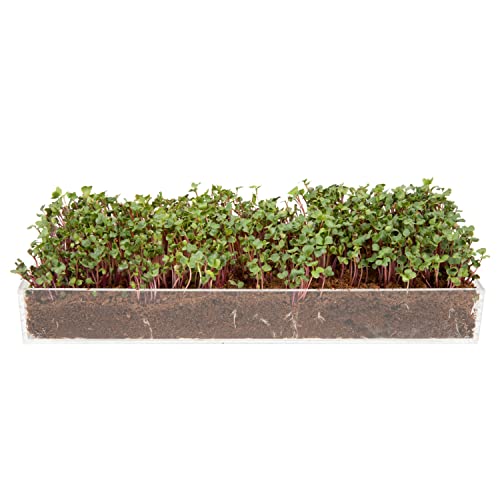
The Window Garden kit is the classic soil-based option, and it suits growers who like a simple, low-tech routine. Non-GMO organic seeds go into fiber soil in a clear acrylic tray, and the included sprayer keeps the surface damp without soaking it. The tray sits on a windowsill or a counter, and the clear sides make it easy to watch roots and stems develop. It is a good fit for a first attempt at microgreens, since the parts are few and the method is forgiving when watering is a little uneven.
Specs
- Seeds: non-GMO organic microgreen seeds
- Growing medium: fiber soil
- Tray: acrylic tray
- Watering: sprayer included
- Use: indoor and outdoor growing
Best for: First-time growers who want a simple soil tray on a sunny sill.
Watch out for: A dark kitchen will leave the greens pale without extra light.
ASIN: B01LWZL5MG
Back to the Roots DIY Microgreen Grow Kit

The Back to the Roots kit is the best way to sample several greens before settling on a favorite. The 6-grow variety pack covers six different microgreen types, so one box gives a household a range of flavors and colors for salads and sandwiches. The kit is designed for indoor growing, and the organic seeds suit growers who care about what goes into their soil. It works well as a gift or a family project, since each variety grows on its own schedule and gives children a reason to check the tray every day.
Specs
- Format: DIY microgreen grow kit, 6-grow variety pack
- Model: 50041
- Seeds: organic
- Growing: indoor
Best for: Households that want to sample six varieties before choosing favorites.
Watch out for: Each variety grows on its own schedule, so harvest days will differ.
ASIN: B085PWHM5J
ZESTIGREENS Self-Watering Microgreens Growing Kit

The ZESTIGREENS kit is the easiest tray to live with, because the self-watering design does most of the work between sowings. A reusable tray holds organic seeds on grow mats under a bamboo frame, and the reservoir below wicks water upward, so the mats stay damp without daily attention. The no-soil setup keeps the counter clean, and the broccoli and salad mix seeds give a mild, crunchy harvest. It is a strong choice for a display countertop, since the bamboo frame looks tidy next to other kitchen tools.
Specs
- Watering: self-watering design with reservoir below the tray
- Tray: reusable indoor grow tray
- Seeds: organic seeds, broccoli and salad mix
- Grow mats: included
- Frame: bamboo frame
- Medium: no soil needed
Best for: Countertops where a tidy, low-effort tray matters.
Watch out for: The tray needs a bright spot, since it has no built-in light.
ASIN: B095Z7QR9T
LUVCOSY Microgreen Growing Trays

The LUVCOSY set is the most flexible option for small batches, because six separate trays let a grower sow different seeds on different days. Each 5-inch tray has a humidity dome with a fine mesh insert, so tiny seeds stay put while moisture stays high during germination. The BPA-free trays suit broccoli, alfalfa, radish, and clover, and the compact size fits a crowded windowsill. It is a good pick for households that want a steady rotation, since one tray can be harvested while the next one is still growing.
Specs
- Pack: 6 trays
- Tray size: 5 x 5 inches
- Cover: humidity dome on each tray
- Mesh: 1.2 mm small mesh holes
- Material: BPA free
- Suits: broccoli, alfalfa, radish, and clover seeds
Best for: Growers who want small batches on a steady rotation.
Watch out for: The trays are soil-free, so seeds need the mesh and dome to stay damp.
ASIN: B0D5D8GWP4
Which One Fits Your Situation
You Have Almost No Time to Tend Plants
Pick the ingarden kit. The LED lights and hydroponic watering run on their own, so the only jobs are sowing the seed pads and cutting the harvest. It suits a busy household or anyone who travels during the week. The trade-off is more parts to clean between crops, but the daily effort is the lowest in this group.
You Want the Simplest Way to Try Microgreens
Pick the Window Garden kit. The soil tray, fiber soil, seeds, and sprayer cover the basics with no electronics and no extra parts. It suits a first attempt on a sunny windowsill, and the clear tray shows roots and stems as they grow. If the greens turn out well, the same tray accepts new seeds for the next round.
You Grow for a Family That Eats Salads Daily
Pick the Back to the Roots variety pack or the LUVCOSY tray set. Six varieties give a household different flavors across the week, while six small trays let a grower sow a fresh batch every few days. Both options keep a steady supply going without a large footprint. Rotate the trays so one is always ready to cut.
You Have Kids Who Want to Watch Plants Grow
Pick the Back to the Roots kit or the Window Garden kit. Six varieties give children different leaves to compare, and a clear tray shows roots spreading below the soil. The daily job is small: a little water and a look at the tray. Harvest day works well as a shared kitchen job, with scissors and a salad bowl ready.
Common Mistakes
- Sowing seeds too thickly, which crowds the tray and leaves the greens thin and weak.
- Overwatering the tray, which can turn the growing medium sour and slow the roots.
- Cutting the greens too late, after the leaves turn tough and the stems grow woody.
- Skipping the blackout or dome stage, which can leave germination patchy across the tray.
- Treating sprouts and microgreens as the same crop, since sprouts grow in jars with rinsing while microgreens grow on a medium and are cut above the root line.
Frequently Asked Questions
How long do microgreens take to grow?
Most microgreens are ready to cut in seven to fourteen days, depending on the variety and the light. Broccoli and radish often finish near the early end of that range, while slower types need a few extra days. Cut the stems just above the growing medium once the first true leaves open, and use the harvest the same day for the best flavor and texture.
Are microgreens the same as sprouts?
No. Sprouts grow in a jar with repeated rinsing, and the whole sprout, roots included, is eaten. Microgreens grow on soil or a mat, develop stems and leaves under light, and are cut above the root line. The two crops use different tools and different habits, so a jar sprouting kit does not work as a microgreens kit and the reverse is also true.
Do microgreens need direct sunlight?
A bright windowsill is usually enough, and several hours of indirect sun will grow sturdy greens. A south-facing or west-facing sill works well in most homes, while a dark corner will leave the stems pale and stretched. A kit with built-in LED lights removes the guesswork in winter or in rooms with small windows, since the light runs on a fixed cycle above the tray.
Can I reuse the trays and mats?
Trays, domes, and frames are made to be reused across many crops, so wash them with warm soapy water and dry them fully between sowings. Fiber and hemp mats are usually single-use, since roots grip them tightly and they break down after one harvest. Soil can be composted after a crop, and fresh seed pads or fresh mats keep the next round clean and even.