We independently review everything we recommend. When you buy through our links, we may earn a commission. As an Amazon Associate we earn from qualifying purchases.
5 Best Backpacking Quilts for the Trail (November 2026)
Compare five backpacking quilts for three-season trails, from ultralight 850-fill down to warm budget options, and pick the right quilt for your pack.
Compare five backpacking quilts for three-season trails, from ultralight 850-fill down to warm budget options, and pick the right quilt for your pack.
A backpacking quilt asks you to give up the hood, the zipper, and the back panel of a sleeping bag, and in exchange it hands back ounces and pack space. That trade only works when the quilt matches the nights you actually sleep out. A quilt that is too warm becomes a sweaty blanket you kick off by midnight, while one that is too light leaves you awake at 3 a.m. listening to the wind. The real decision is which balance of warmth, weight, and packed size fits your trips.
This guide is for thru-hikers counting every gram, weekend backpackers who want a lighter sleep system, and hammock campers looking for a top quilt that doubles as a camp blanket. The five quilts below were chosen from the names and specifications shown on their Amazon product pages, with attention to fill power, shell fabric, weight, size, and the small features, like pad straps and draft collars, that decide whether a quilt stays sealed around you all night.
Quick Picks
As an Amazon Associate we earn from qualifying purchases
Product
Best for
Key spec from title
Featherstone Moondance 25
Thru-hikers who want premium warmth at a low weight
850 fill power down top quilt
Get Out Gear Down Camping Blanket
Budget backpackers who want a light, versatile quilt
650 fill power down, packable
ZOOOBELIVES Alplive R300
Warm-weather trips where pack size matters most
650 fill power, 1.35 lb
OneTigris Down Camping Blanket
Campers who want a quilt that also works as a poncho
600 fill power duck down
Paria Thermodown 15
Cold three-season nights on a budget
700 fill power down, 15 degree rating
How to Choose
Match the Temperature Rating to Your Coldest Night
A quilt’s temperature rating is the first number to read, and the most commonly misunderstood. A quilt rated to 25 degrees is built for nights that drop toward that figure, not for nights that stay comfortably above it, so buy for the coldest night you expect, not the average one. If your trips run from late spring to early autumn in the mountains, a quilt rated in the 20 to 30 degree range covers most of those nights, while one rated near 45 degrees suits summer lowlands. Cold sleepers should pick a warmer rating than the forecast suggests, because a quilt that is slightly too warm can be vented by loosening the footbox.
Weigh Fill Power Against Total Weight
Fill power measures how much space an ounce of down fills, and higher fill power means more loft and more warmth for the same weight. A quilt with 850 fill power down traps more air per ounce than one with 600 fill power, so it can be warmer while weighing less, which is why the lightest quilts in this guide carry the highest fill numbers. Total weight still matters on its own, because shell fabric, zippers, straps, and draft collars all add grams that fill power cannot erase. Compare the stated total weight in the size you would actually buy, since a long and wide version can weigh several ounces more than the regular.
Look at the Shell Fabric and the Footbox
The shell fabric decides how a quilt handles wind, dew, and the rough ground beside your sleeping pad. Most backpacking quilts use a 10D or 20D nylon shell, where the lower number means a lighter and thinner fabric that packs smaller but needs more care around sharp branches and rocky tent floors. A durable water repellent finish helps the shell shed light moisture, though no thin nylon quilt is a rain shelter, so a pack liner still matters in wet weather. The footbox is the other half of the warmth equation: a sewn or zippered footbox with a drawstring seals heat around your feet, while a flat blanket with snaps leaves a gap that cold air finds.
Check Packed Size and Versatility Before You Buy
A quilt that weighs little but packs large still eats pack space, so read the packed dimensions as carefully as the weight. Quilts that fold into a bundle near the size of a water bottle leave room for food and layers, while one that packs to the size of a loaf of bread may force a larger pack. Versatility can make a heavier quilt worth carrying: a quilt with snap buttons can open flat as a blanket at camp, wrap around your shoulders as a poncho on a chilly morning, or serve as an underquilt in a hammock.
The 5 Best Options
Featherstone Moondance 25
Top Pick
Featherstone Moondance 25
Best for: Thru-hikers and three-season backpackers who want premium warmth at a low weight.
Thru-hikers and three-season backpackers who want premium warmth at a low weight.
Watch out for
The thin 10D shell needs care around sharp branches and rough ground, and the Regular size suits sleepers up to about 5 feet 10 inches, so taller hikers should check the Long/Wide size.
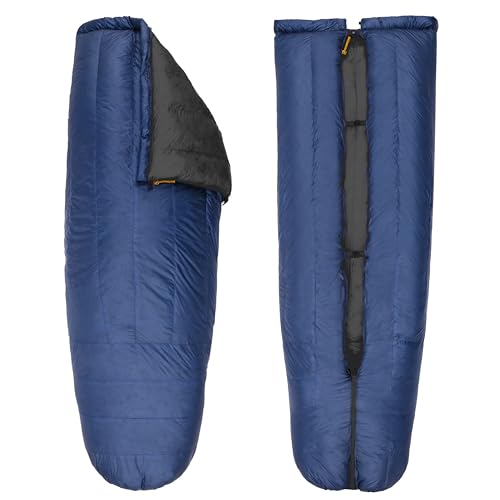
The Featherstone Moondance 25 is the quilt in this group built most like a dedicated backpacking top quilt, and it shows in the details. Its 850 fill power down lofts high for its weight, the draft collar seals the gap at the back of the neck where cold air usually sneaks in, and the included pad straps keep the quilt attached to a sleeping pad when the sleeper turns. A zippered footbox with a drawstring closes around the feet, and the quilt can also open flat as a blanket or serve as a hammock underquilt.
Get Out Gear Down Camping Blanket
The Get Out Gear Down Camping Blanket is the budget pick that covers the most ground for the least weight. At just over a pound it packs into a small stuff sack, and its snap system turns it into a poncho for hands-free warmth around camp, a feature the dedicated top quilts in this group do not offer. The 650 fill power down gives solid warmth for summer and shoulder-season nights, and the 20D ripstop nylon shell with a durable water repellent finish resists wind, spills, and dirt.
Specs
Fill: 650 fill power down
Shell: 20D ripstop nylon with durable water repellent finish
Weight: 1 lb 1 oz
Size when open: 80 x 54 inches
Packed size: 5 x 12 inches in the included stuff sack
Snap buttons convert the blanket into a poncho
Stuff sack with heavy-duty clasp included
Machine washable in a top-load washer
Best for: Budget backpackers and camp loungers who want a light quilt that doubles as a poncho.
Watch out for: The blanket has no shaped footbox or draft collar, so drafts can reach the feet and neck on colder nights, and the water repellent finish handles drizzle rather than steady rain.
ASIN: B083WGX2LH
ZOOOBELIVES Alplive R300
Runner-Up
ZOOOBELIVES Alplive R300
Best for: Warm-weather backpackers who want the smallest, lightest down quilt for mild nights.
Warm-weather backpackers who want the smallest, lightest down quilt for mild nights.
Watch out for
The 650 fill power and light fill weight suit mild nights rather than cold mountain evenings, and the open size is generous but the quilt has no footbox, so cold sleepers should pair it with warm layers.
The ZOOOBELIVES Alplive R300 is the warm-weather specialist of this group, built around a simple idea: carry as little as possible and still sleep warm on mild nights. Its 650 fill power duck down fills a 20D ripstop nylon shell, and the whole quilt weighs 1.35 lb and packs to a bundle about a foot long, which slips into a pack corner without a fight. The snap design lets it open flat or close up for sleeping, and the listing includes both a stuff sack and a mesh storage bag.
OneTigris Down Camping Blanket
OneTigris Down Camping Blanket
Best for: Campers who want one quilt that works as a blanket, a top quilt, and a poncho.
Campers who want one quilt that works as a blanket, a top quilt, and a poncho.
Watch out for
The 600 fill power and the warm temperature range make this a mild-weather quilt, so it will not keep up on cold mountain nights, and the wide flat cut can draft without pad straps.
The OneTigris Down Camping Blanket is the most flexible piece in this guide, and that flexibility is the reason to pick it. Snap buttons let it change from a flat blanket into a top quilt for a tent or hammock, or into a poncho or cloak for hands-free warmth around camp. Its 600 fill power duck down sits inside a 20D nylon shell with a 300T polyester lining, and the one-person version weighs 24.7 oz and folds into a pouch about 10 inches long. A two-person version is also listed for couples who share a quilt.
Paria Thermodown 15
Paria Thermodown 15
Best for: Budget backpackers who camp in cold three-season conditions and need a warm rating.
Budget backpackers who camp in cold three-season conditions and need a warm rating.
Watch out for
At over two pounds it is the heaviest quilt here, so ultralight hikers should weigh it against the lighter options, and the down is not treated for water resistance, so it suits dry conditions best.
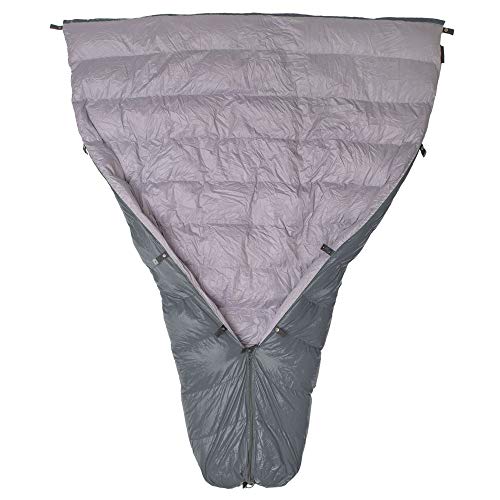
The Paria Thermodown 15 is the cold-weather workhorse of this group, built for nights that drop well below freezing. It carries 22 ounces of 700 fill power down in the Regular size, far more fill than the lighter quilts here, and that fill is what earns its 15 degree rating. The quilt measures 78 by 56 inches in Regular and 84 by 57 inches in Long, with a 20D ripstop nylon shell, a 320T polyester lining, and a sleeping pad strap that holds it in place.
Which One Fits Your Situation
You Are Thru-Hiking and Counting Every Ounce
Pick the Featherstone Moondance 25. Its 850 fill power down gives the best warmth for its weight in this group, and the draft collar, footbox, and pad straps solve the draft problems that make lighter blanket-style quilts frustrating on a long trail. The Long/Wide size covers taller hikers, and the quilt doubles as a hammock underquilt if your shelter changes along the way.
You Want the Lightest Quilt for Summer Nights
Pick the ZOOOBELIVES Alplive R300. At 1.35 lb with a packed size near a foot long, it adds the least bulk to a summer pack while still giving real down insulation for mild nights. The snap design and the included mesh storage bag make it easy to live with, though you should leave it home when the forecast calls for a cold mountain night.
You Camp on a Budget and Want One Quilt for Everything
Pick the Get Out Gear Down Camping Blanket. It weighs just over a pound, packs small, and turns into a poncho at camp, so one purchase covers sleeping, lounging, and chilly mornings. It is the best value here for warm and shoulder-season trips, and its simple design means there is little to go wrong on the trail.
You Camp Late Into Autumn or Early in Spring
Pick the Paria Thermodown 15. Its 15 degree rating and 22 ounces of fill handle nights the lighter quilts cannot, and the pad strap and compression sack make it practical despite the extra weight. Accept the two-plus-pound carry as the cost of sleeping warm when the temperature drops, and keep it dry, since the down is not treated for water resistance.
Common Mistakes
Buying by the temperature number alone without checking whether it is a comfort rating or a lower limit, then shivering on the coldest night of the trip.
Choosing the lightest quilt available and discovering on the trail that it has no footbox, no pad straps, and no draft collar to stop cold air.
Ignoring packed size and finding that a light quilt still fills a third of the pack because it does not compress well.
Storing a down quilt compressed in its stuff sack for months, which flattens the loft and reduces warmth on the next trip.
Skipping a sleeping pad with enough insulation and blaming the quilt for a cold night, when heat was escaping downward into the ground.
Frequently Asked Questions
What is the difference between a backpacking quilt and a sleeping bag?
A backpacking quilt drops the hood, the full zipper, and the insulation underneath the sleeper, since a sleeping pad provides the insulation below. That saves weight and pack space, and lets restless sleepers move more freely. The trade is that a quilt relies on pad straps, a footbox, and a draft collar to seal out cold air, so those features matter more than they do in a sleeping bag.
How warm should a backpacking quilt be for three-season use?
For most three-season trips, a quilt rated near 20 to 30 degrees covers spring and autumn nights in the mountains, while one rated near 45 degrees suits summer lowlands. Cold sleepers should choose a warmer rating than the forecast suggests, because a quilt that is slightly too warm can be vented, while one that is too cold has no fix in the middle of the night.
Can a backpacking quilt work in a hammock?
Yes, and many quilts in this guide are built for it. A top quilt works the same way in a hammock as it does on the ground, draping over the sleeper and sealing at the footbox. Some quilts also convert into an underquilt that hangs beneath the hammock. Either way, a hammock sleeper still needs insulation underneath, since cold air moves freely below the hammock.
How do I store a down backpacking quilt between trips?
Store it loose in a large mesh or cotton bag, or hang it in a closet, so the down keeps its loft. Never leave it compressed in a stuff sack for weeks, since long compression flattens the down and reduces warmth. Before a trip, shake the quilt out and let it loft, and wash it only with a cleaner made for down, then dry it fully on low heat.
9
99klik Editorial Team
We compare specs, materials and verified owner reviews before a product earns a spot. Rankings are never paid.
Affiliate disclosure. As an Amazon Associate we earn from qualifying purchases at no extra cost to you. Prices accurate as of the date shown.
Five prebuilt gaming computers with RTX graphics, fast memory, and roomy SSDs compared side by side, so you can match a desktop to your games and desk.
Discover the best smartwatches for iPhone under 200 with long battery life, built-in GPS and health tracking for everyday fitness on iOS. Top picks compared.
Explore the best 8K video cameras for filmmakers and hybrid shooters, with full-frame sensors, RAW recording, reliable autofocus and pro codecs. Compared.
Best race bike tyres 2: a second, tubeless-ready roundup covering the Continental GP5000 S TR, Schwalbe Pro One TLE, Pirelli P Zero Race TLR and Vittoria Corsa Pro TLR.
A second-round guide to cheap bike helmets for adult everyday riders: four CPSC-certified value picks compared on fit, ventilation, and safety features, with sizing and buying advice — no prices, just value.
Looking for the best bike for wheelies? These 20-inch BMX picks offer the short rear end, strong frame and simple gearing that make learning to wheelie easier.
Shopping for the best beginner road bike under 2000? These mid-range aluminum picks with Shimano Claris and Tiagra groupsets are built to learn on and keep.
An informational guide to 10440 rechargeable batteries: what the size code means, lithium chemistries, voltage and capacity, compatible devices, charging, and safety — and why there is no affiliate product list here.



 Paria Thermodown 15