We independently review everything we recommend. When you buy through our links, we may earn a commission. As an Amazon Associate we earn from qualifying purchases.
Best Golf Binoculars
Best golf binoculars means a laser rangefinder: compare five golf rangefinders with slope, flag lock and 6x magnification for exact yardages on every hole.
Best golf binoculars means a laser rangefinder: compare five golf rangefinders with slope, flag lock and 6x magnification for exact yardages on every hole.
Disclosure: As an Amazon Associate, this site may earn from qualifying purchases made through links on this page.
Golfers who search for golf binoculars almost always mean one thing: a laser rangefinder. A traditional pair of binoculars shows the course in two barrels, but it cannot tell you how far the flag is. A laser rangefinder is a single-tube device that measures the exact yardage to the flag, adjusts for slope, and locks onto the pin with a short vibration — and that is the tool golfers actually carry.
This guide covers five laser rangefinders that fit the golf binoculars search: two Bushnell Tour models, the Callaway 300 Pro, the Precision Pro Titan Elite with Bluetooth GPS, and the Blue Tees Series 3 Max+. All five carry 6x magnification, slope measurement, and a flag-lock signal, and all five are sold on Amazon US. If you want to stop guessing distances and start picking clubs with confidence, one of these five belongs in your bag.
At a Glance
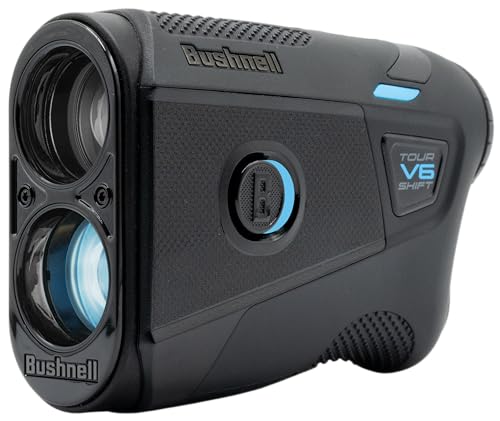
Bushnell Tour V6 Shift — 1300-yard range, slope compensation, flag lock vibration, and a magnetic cart mount.
Bushnell Tour V7 Shift — 1300-yard range with a dual color display, slope technology, and yardage range recall.
Callaway 300 Pro Slope — 1000-yard rangefinder with an external slope switch and 6x magnification.
Precision Pro Titan Elite — Bluetooth GPS distances shown inside the viewfinder, plus slope and 6x magnification.
Blue Tees Series 3 Max+ — 1000-yard rangefinder with a slope switch, magnetic strip, and flag lock.
How to Choose
Range decides how far you can measure. The two Bushnell models reach 1300 yards, which covers even the longest par 5 from the back of the tee. The Callaway and Blue Tees models reach 1000 yards, which is more than enough for any approach shot and most tee shots. For flag distances, the number that matters is accuracy at 100 to 250 yards, and all five models are built for that band.
Slope measurement adjusts for elevation. A flat 150-yard shot and a 150-yard shot uphill need different clubs, and slope mode does the math for you. All five rangefinders here include slope, and the Bushnell, Callaway, and Blue Tees models add a slope switch, so the feature can be turned off for tournament rounds where slope is not allowed. Check your event rules before using slope mode in competition.
Flag lock confirms you measured the pin, not the trees behind it. Every model here signals a lock when it finds the flag: the Bushnell models vibrate, the Callaway uses Pin Acquisition Technology, and the Blue Tees locks onto the flag as well. Without a lock signal, a reading can come from a bunker or a tree behind the green, so this feature is worth having on any rangefinder you buy.
Magnification and display shape what you see. All five models use 6x magnification, which brings the flag close enough to aim at from 200 yards. The Bushnell Tour V7 Shift adds a dual color display, which stays readable in low light and against dark backgrounds. The Precision Pro Titan Elite adds something different: Bluetooth GPS distances shown inside the viewfinder, so you see front, middle, and back yardages next to the laser reading.
Magnet and size decide how it rides in the bag. The Bushnell models include a magnetic cart mount that sticks the rangefinder to a cart frame, and the Blue Tees includes a magnetic strip for the same purpose. A magnet keeps the device within reach between shots instead of buried in a pocket. Size and weight matter on foot: a compact rangefinder slips into a pocket, while a larger one rides better on a cart.
Battery and weather resistance keep it running. Laser rangefinders run on small batteries that last a season or more under normal use, and the Bushnell models add water resistance for wet rounds. Carry a spare battery in the bag, and keep the lens clean — a dirty lens is the most common cause of slow or missed readings.
The Bushnell Tour V6 Shift is the reference rangefinder in this guide. It measures out to 1300 yards with 6x magnification, and its slope compensation adjusts yardages for uphill and downhill shots. PinSeeker with JOLT locks onto the flag and answers with a short vibration, so you know the reading is the pin and not the trees behind the green. A BITE magnetic cart mount sticks the unit to a cart frame between shots.
The V6 Shift has been the standard other rangefinders are judged against, and the reason is consistency: it locks onto flags quickly, it holds its accuracy in wind and light rain, and the slope switch lets it move from a casual round to a tournament-legal setup in one motion. The 1300-yard range covers the longest holes on the course, and the 6x optics bring the flag close enough to aim at from well beyond 200 yards. For a golfer who wants the proven pick with no weak spots, the Tour V6 Shift is the one.
The Bushnell Tour V7 Shift is the newer Bushnell in this guide, and it builds on the V6 with a dual color display and yardage range recall. It keeps the 1300-yard range, 6x magnification, and Tour Trusted Slope Technology of its sibling, and it adds a display that switches between red and black readouts so the numbers stay visible against bright sky or dark trees. Yardage range recall shows the last few readings, which helps when comparing distances on a tricky hole.
The dual color display is the reason to pick the V7 over the V6. On a bright day, black numbers can wash out against the sky; on a dark background, red numbers stay sharp. The V7 also refines the optics and the slope system, so readings come a touch faster and the slope-adjusted number is easier to trust. It carries the same magnetic mount and the same tournament-legal slope switch as the V6. For a golfer who wants the newest Bushnell optics and the clearest display in this guide, the Tour V7 Shift is the pick.
The Callaway 300 Pro Slope is the most affordable pick among the big names here. It measures out to 1000 yards with 6x magnification, and its Pin Acquisition Technology locks onto the flag to within a yard. An external slope switch sits on the outside of the body, so slope can be turned on or off without opening a menu — a small detail that matters when a playing partner asks whether slope is off before a tournament round.
The 300 Pro is also the most compact rangefinder in this guide, which suits golfers who walk and carry the device in a pocket. The 1000-yard range covers every approach shot and most tee shots, and the slope-adjusted reading helps with club selection on hilly courses. Callaway’s golf pedigree shows in the ergonomics: the unit sits well in the hand, the button falls under the finger, and the display is easy to read. For a golfer who wants a trusted brand and tournament-ready slope control at a lower spend than the Bushnell models, the Callaway 300 Pro Slope is the pick.
The Precision Pro Titan Elite is the only rangefinder here with Bluetooth GPS built in, and that changes how it gets used. Pair it with the Precision Pro app and the viewfinder shows GPS distances to the front, middle, and back of the green beside the laser reading, so you get two kinds of yardage in one look. It also carries slope measurement and 6x magnification, so it works as a full laser rangefinder even without the phone connected.
The GPS overlay is genuinely useful on unfamiliar courses. A laser reading tells you the flag distance, but the GPS distances tell you how much green sits behind the flag and how much room a long shot has to land safely. That extra context helps with club choice on approach shots and with layup decisions on par 5s. The Titan Elite is also built for the course, with a rugged body and a comfortable grip. For a golfer who plays new courses often and wants GPS context inside the viewfinder, the Titan Elite is the pick.
The Blue Tees Series 3 Max+ closes the guide as the most approachable rangefinder here. It measures out to 1000 yards with 6x magnification, and it includes a slope switch, a magnetic strip, and flag lock — the same core feature set as the bigger names, in a smaller and simpler package. The magnetic strip sticks the unit to a cart frame or a bag strap, so it stays within reach all round.
Blue Tees built its name on rangefinders that do the essentials well without a complicated menu, and the Series 3 Max+ follows that pattern. The slope switch is on the body, the flag lock confirms the reading, and the auto-ambient display adjusts brightness to the light. It is a good first rangefinder for a golfer moving from guessing distances to measuring them, and a good spare for a golfer who wants a second unit for a cart bag. For straightforward yardages with slope and a magnet at the lowest spend in this guide, the Series 3 Max+ is the pick.
Comparison Table
Rangefinder
Max Range
Magnification
Slope
Standout Feature
Bushnell Tour V6 Shift
1300 yards
6x
Yes, with switch
Flag lock vibration, magnetic mount
Bushnell Tour V7 Shift
1300 yards
6x
Yes, with switch
Dual color display, yardage recall
Callaway 300 Pro Slope
1000 yards
6x
Yes, external switch
Pin Acquisition Technology
Precision Pro Titan Elite
1000-yard class
6x
Yes
Bluetooth GPS in viewfinder
Blue Tees Series 3 Max+
1000 yards
6x
Yes, with switch
Magnetic strip, auto-ambient display
Which One Fits Your Situation
You want the proven standard: take the Bushnell Tour V6 Shift. Its 1300-yard range, flag lock vibration, and magnetic mount have made it the reference rangefinder for years.
You want the clearest display: take the Bushnell Tour V7 Shift. The dual color display stays readable in any light, and yardage recall adds a useful memory for tricky holes.
You walk the course and want a trusted brand: take the Callaway 300 Pro Slope. It is compact, it locks onto the flag quickly, and the external slope switch is tournament-ready.
You play unfamiliar courses: take the Precision Pro Titan Elite. Bluetooth GPS distances in the viewfinder show front, middle, and back yardages beside the laser reading.
You want the essentials at the lowest spend: take the Blue Tees Series 3 Max+. Slope, flag lock, and a magnetic strip cover the core job without a complicated menu.
FAQ
Are golf binoculars the same as laser rangefinders?
Not exactly, but golfers use the two terms for the same job. Traditional binoculars show the course through two barrels without measuring distance, while a laser rangefinder measures the exact yardage to the flag. This guide covers rangefinders because they are the tool golfers actually use for distances.
Is slope legal in tournaments?
Slope must be turned off in most tournament rounds. The Bushnell, Callaway, and Blue Tees models in this guide have a slope switch on the body, so the feature can be disabled before a round. Always check the rules of your event before teeing off.
How accurate are laser rangefinders?
Laser rangefinders are accurate to about a yard at flag distances, which is far closer than pacing or guessing. The flag lock signal on these models confirms the reading came from the pin rather than from trees or bunkers behind the green.
Do I need GPS as well as a laser?
A laser alone covers flag distances, which is what most shots need. GPS adds front, middle, and back yardages, which help with layups and with judging how much green sits behind the flag. The Precision Pro Titan Elite gives you both in one device.
What battery do rangefinders use, and how long does it last?
Most laser rangefinders run on a small CR2 battery that lasts a season or more under normal use. Carry a spare in your bag, and keep the lens clean — a dirty lens is the most common cause of slow readings.
Final Take
The best golf binoculars are laser rangefinders, and the five in this guide cover every kind of golfer. The Bushnell Tour V6 Shift is the proven standard, the Tour V7 Shift adds the clearest display, the Callaway 300 Pro Slope is the compact tournament-ready pick, the Precision Pro Titan Elite adds GPS context in the viewfinder, and the Blue Tees Series 3 Max+ covers the essentials at the lowest spend. Pick the one that matches how you play, and the guessing stops on the next round.
9
99klik Editorial Team
We compare specs, materials and verified owner reviews before a product earns a spot. Rankings are never paid.
Affiliate disclosure. As an Amazon Associate we earn from qualifying purchases at no extra cost to you. Prices accurate as of the date shown.
The best mattresses for someone under 125 pounds: soft and medium beds that give way under a lighter sleeper, from a plush queen to narrow and standard twins.
The best adirondack chairs all weather picks in HDPE: five outdoor chairs that shrug off rain, sun, and snow, from folding pairs to a wide oversized set.
Find the best inexpensive smartphones for Verizon in this guide: five affordable 5G phones with big displays, strong cameras and batteries that last all day.
Compare the best x99 motherboards tomshardware readers still pick for Xeon E5 and Core i7 builds: five MACHINIST LGA 2011-3 boards by size, memory and storage.
Find the best sensor size for mirrorless cameras by comparing full-frame, APS-C and Micro Four Thirds bodies on image quality, low light, size and cost.
Compare adjustable chairs for home and office use by seat height, lumbar support, headrest and armrest adjustment, tilt, swivel and stated capacity today.
Galaxy Z Flip vs Galaxy S20 Ultra compared on display, cameras, battery and size, with five Amazon Renewed picks to help you choose the right 2020 Samsung.
Best Japanese vegetable cleaver guide: five nakiri knives compared on steel, edge angle, handle and weight, so you can pick the right one for produce prep.

 Bushnell Tour V6 Shift
 Bushnell Tour V7 Shift
 Callaway 300 Pro Slope
 Precision Pro Titan Elite
 Blue Tees Series 3 Max+