We independently review everything we recommend. When you buy through our links, we may earn a commission. As an Amazon Associate we earn from qualifying purchases.
5 Best Sieves for Straining and Sifting (November 2026)
Strain stocks and sift flour cleanly with the best sieves, from fine mesh rounds to sturdy rimmed sets, with mesh size, diameter, and grip compared.
Strain stocks and sift flour cleanly with the best sieves, from fine mesh rounds to sturdy rimmed sets, with mesh size, diameter, and grip compared.
A sieve looks simple until you use a bad one. Mesh that flexes under a ladle, a rim that bends the first time you press it against a pot, a handle that slips when your hands are wet — small flaws turn a two-minute job into a mess. The right sieve holds its shape, catches the fine bits you want gone, and lets liquid through without a fight. This guide covers five round mesh sieves that do exactly that, from a single commercial-style workhorse to a three-size set for a first kitchen.
Every pick below is a round mesh sieve built for straining liquids and sifting dry goods. You will not find conical chinois strainers, spider skimmers, or rotary flour sifters here — those are different tools with different jobs. What you will find is a clear comparison of mesh fineness, bowl diameter, rim strength, and handle grip, so you can match the sieve to the way you cook.
Quick Picks
As an Amazon Associate we earn from qualifying purchases
Product
Best for
Key spec
Winco MS3A-8S Single Fine Mesh Strainer
Heavy daily use
8-inch bowl, single fine mesh, 1 mm openings
OXO Good Grips Double Rod Strainer
All-round stock and sauces
8-inch bowl, double-rod rim, soft grip handle
Kafoor Large Fine Mesh Strainer
Big batches and hot liquids
9-inch bowl, heat-resistant rubber handle
Tiawudi Large Fine Mesh Strainer
Fine grains and flour
9-inch bowl, 30 mesh extra fine, two layers
OXO Good Grips 3-Piece Strainer Set
Covering three sizes at once
3-, 6-, and 8-inch strainers in one set
How to Choose
Mesh fineness
Mesh fineness decides what a sieve catches and how fast liquid passes. A 1-millimeter opening or a 30-mesh weave traps quinoa, fine flour, and small seeds, while a coarser mesh drains pasta water in seconds but lets fine grains slip through. For stock and sauces, fine mesh gives a clearer result, since it holds back the small solids that cloud a broth. For rinsing rice and berries, medium-fine mesh is enough and drains faster. Think about the smallest thing you strain often, then pick a mesh one step finer than that. A sieve that is too coarse wastes the effort; one that is too fine turns every pour into a wait.
Bowl diameter
Bowl diameter sets how much a sieve holds and which pots it spans. An 8-inch bowl suits everyday jobs: rinsing a cup of rice, straining a quart of stock, sifting flour over a sheet pan. A 9-inch bowl covers bigger batches and rests more securely across wide pots and mixing bowls. Go smaller only for single jobs like straining citrus juice or dusting sugar, where a 3-inch mini is easier to control. Measure the bowls and pots you use most, then pick a sieve that sits across the rim without tipping. A bowl that is too wide for your pots wobbles; one that is too narrow sinks into the liquid.
Rim and handle strength
The rim and handle carry every load a sieve takes, so they deserve a close look. A double-rod rim holds the basket round when you press a ladle through hot stock, while a single thin wire bends and stays bent. A riveted handle stays attached after years of use, and a wide hook lets the sieve rest on a bowl without sliding. Soft grips help when hands are wet, and a loop at the far end keeps the tool steady while you pour with both hands. Pick the sieve up if you can and press the rim gently — a sturdy frame resists the push, while a weak one flexes at once.
Material and cleanup
Most round sieves use stainless steel mesh, which resists rust and handles hot liquids without warping. Wooden handles feel warm in the hand but need drying after washing, while rubber and plastic grips stay secure when wet and wipe clean fast. Fine mesh clogs faster than coarse mesh, so rinse the sieve right after use and brush the mesh from the underside to push trapped bits out. A quick rinse after use keeps the mesh clear far longer than a weekly deep clean, and a dishwasher cycle handles the rest when the maker allows it. Avoid scouring pads on fine mesh — they snag the wires and open gaps.
The 5 Best Options
Winco MS3A-8S Single Fine Mesh Strainer, 8-Inch
Top Pick
Winco MS3A-8S Single Fine Mesh Strainer, 8-Inch
Best for: Cooks who want one tough sieve for daily straining and rinsing.
The Winco MS3A-8S is the plain workhorse of this list. It comes from a brand that supplies commercial kitchens, and the design shows it: a deep stainless bowl, a single layer of fine mesh, and a wooden handle with a hook that rests on a bowl rim. The mesh opening measures 1 millimeter, fine enough to catch quinoa and small seeds while stock flows through fast. At 14 inches long it reaches across wide pots, and the all-metal bowl shrugs off heat and dishwasher cycles. Nothing here is decorative, and that is the point — it is built for daily use.
Watch out for: The 8-inch bowl is a mid-size choice, so very large batches need two passes.
OXO Good Grips Double Rod Strainer, 8-Inch
Runner-Up
OXO Good Grips Double Rod Strainer, 8-Inch
Best for: Straining stock and sauces without the rim bending.
The OXO Good Grips 8-Inch Double Rod Strainer fixes the failure that kills most sieves: a rim that bends. Two parallel steel rods run around the rim, so the basket stays round when you press a ladle through a pot of stock. The soft handle stays secure in wet hands, and a loop at the far end hooks over a bowl or pot so you can pour with both hands free. The 8-inch bowl is wide enough to clarify a quart of stock in seconds, yet shallow enough to sift flour evenly across a sheet pan. Dishwasher safe, and sold in 6-inch and 3-inch sizes too.
Watch out for: The 8-inch size suits everyday pots, so oversized stockpots need a larger sieve.
Kafoor Large Fine Mesh Strainer, 9-Inch
Kafoor Large Fine Mesh Strainer, 9-Inch
Best for: Big batches of pasta, rice, and berries.
Brand: Kafoor
Model: 9 Inch Parent
Diameter: 9 inches (also sold in 7-inch and 10-inch sizes)
The Kafoor 9-inch strainer is the big-batch pick. Its bowl measures 9 inches across with a 3-inch depth, so it holds a generous amount of rice, pasta, or berries without spilling over the rim. The thermoplastic rubber handle stays cool and steady when steam rises from a hot pot, and the wide hook lets the strainer rest on a bowl while you work. The fine mesh catches small grains and sifts flour without clogging, and the whole tool weighs only 7 ounces, so long sessions at the sink stay comfortable. A lifetime warranty backs the build.
Watch out for: The 9-inch bowl is wide, so check it fits over your usual mixing bowls.
Tiawudi Large Fine Mesh Strainer, 9-Inch
Tiawudi Large Fine Mesh Strainer, 9-Inch
Best for: Rinsing quinoa and sifting fine dry goods.
The Tiawudi 9-inch strainer is built for the finest jobs. Its mesh is rated 30 mesh and woven in two tight layers, so it traps quinoa, fine flour, and small seeds that slip through coarser sieves. The bowl is 18/8 stainless steel, food grade and free of lead and cadmium, with a riveted handle and a wider hook that keeps it from sliding off a bowl. At 17.5 inches long it spans large pots and mixing bowls with ease. If you rinse grains daily or sift dry goods often, this is the sieve that catches what others miss.
Watch out for: The extra fine mesh drains slowly with thick batters, so stir gently to keep liquid moving.
OXO Good Grips 3-Piece Strainer Set
OXO Good Grips 3-Piece Strainer Set
Best for: Kitchens that need three sizes without buying three singles.
Brand: OXO
Model: 11344300
Set includes: 3-inch, 6-inch, and 8-inch strainers
The OXO Good Grips 3-Piece Strainer Set covers the three sizes a kitchen actually uses. The 8-inch strainer handles stock and pasta, the 6-inch one rinses berries and grains, and the 3-inch mini strains citrus juice and dusts powdered sugar. Wide plastic rims keep each strainer stable on pots and bowls, and holes in the handles let you hang the set for storage. The fine mesh is the same across all three, so small jobs get the same clean result as big ones. One set replaces three separate buys.
Watch out for: The set takes more drawer space than a single strainer, so use the handle holes to hang it.
Which One Fits Your Situation
You make stock and sauces most nights
Reach for the OXO 8-inch Double Rod first. The double-rod rim stays round under a ladle, the loop hooks over the pot so both hands stay free, and the fine mesh leaves broth clear. Keep the Winco 8-inch beside it for rinsing grains between steps — the two cover nearly every pot on the stove.
You bake and sift flour often
Pick the Tiawudi 9-inch for the finest sifting — its two-layer 30-mesh weave catches lumps that coarser sieves miss. The Kafoor 9-inch is the second hand for larger amounts of flour and sugar, with a heat-resistant handle that stays cool near a warm oven. Together they cover small and large bakes.
You rinse rice, quinoa, and berries daily
Go with the Winco 8-inch for everyday rinsing — the 1-millimeter mesh catches quinoa without slowing the drain, and the hook rests the sieve on any bowl. Add the Tiawudi 9-inch when you rinse larger amounts of grain, since its wider bowl and finer weave handle volume without spilling at the sink.
You are setting up a first kitchen
Buy the OXO 3-Piece Strainer Set and stop there. Three sizes cover citrus, berries, grains, pasta, and stock, the wide rims sit steady on pots and bowls, and the handle holes let the set hang out of the way. Add a single Winco 8-inch later if one sieve ends up doing all the work.
Common Mistakes
Pressing a ladle hard against a single-wire rim, which bends the basket out of round.
Sifting flour through a mesh that is too coarse, then finding lumps in the batter.
Letting fine mesh dry with food stuck in it, which clogs the weave and slows every later pour.
Resting a plastic-rimmed set on the edge of a hot pot, which can warp the rim.
Buying a bowl that is wider than every pot you own, so the sieve wobbles instead of sitting steady.
Frequently Asked Questions
What mesh size do I need for flour?
Fine mesh around 1 millimeter or 30 mesh works for most flour and powdered sugar. It catches lumps and stray bits while letting the flour fall through in an even shower. Coarser mesh leaves lumps behind, and extra-fine mesh slows the job down. If you sift cocoa or icing sugar often, the finer end of the range is the safer pick.
Can I use a fine mesh sieve for hot stock?
Yes, if the sieve is stainless steel with a sturdy rim. Metal mesh handles boiling liquid without warping, and a double-rod rim or riveted handle keeps the basket steady under a ladle. Keep your hands clear of the steam, rest the sieve on the pot rim with its hook or loop, and pour slowly so the mesh does not clog mid-pour.
How do I clean a fine mesh sieve?
Rinse it right after use, while food is still soft. Run water from the underside so trapped bits push back out through the mesh, then brush gently with a soft brush if anything stays behind. Let it air dry fully before putting it away, since trapped moisture dulls steel over time. Skip scouring pads — they snag fine wires and open gaps in the weave.
Is one sieve enough, or do I need a set?
One good 8-inch sieve covers most kitchens: stock, pasta, rice, berries, and flour all pass through it. A set earns its place when you often switch between tiny jobs and big ones — a 3-inch mini for citrus, a 6-inch for berries, an 8-inch for stock. If your drawer space is tight, buy the single first and add sizes only when one sieve ends up doing everything.
9
99klik Editorial Team
We compare specs, materials and verified owner reviews before a product earns a spot. Rankings are never paid.
Affiliate disclosure. As an Amazon Associate we earn from qualifying purchases at no extra cost to you. Prices accurate as of the date shown.

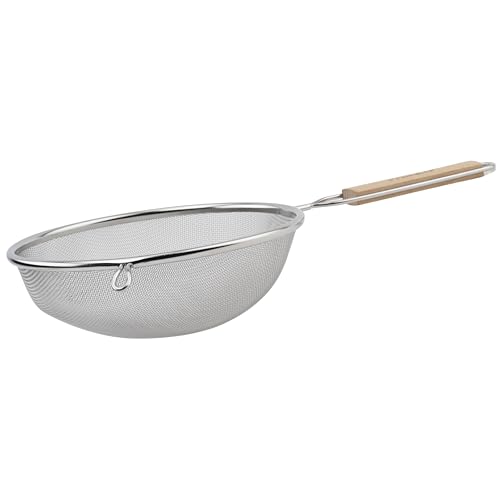


 Tiawudi Large Fine Mesh Strainer, 9-Inch
 OXO Good Grips 3-Piece Strainer Set