We independently review everything we recommend. When you buy through our links, we may earn a commission. As an Amazon Associate we earn from qualifying purchases.
Best Beginner Road Bike Under 2000: Mid-Range Picks Worth Growing Into
Shopping for the best beginner road bike under 2000? These mid-range aluminum picks with Shimano Claris and Tiagra groupsets are built to learn on and keep.
Shopping for the best beginner road bike under 2000? These mid-range aluminum picks with Shimano Claris and Tiagra groupsets are built to learn on and keep.
As an Amazon Associate we earn from qualifying purchases.
Affiliate Disclosure: This article contains affiliate links. If you buy through links on this page, we may earn a commission from qualifying purchases, at no extra cost to you. Product details and availability are taken from the manufacturer’s and retailer’s listings; we have not personally tested these bikes.
There is a meaningful difference between the cheapest drop-bar bikes and the mid-range tier this guide covers. At the entry floor of the market, you often get a heavy frame, a drivetrain from an unfamiliar maker, and components that are hard to service. Step up into the mid-range segment, and the picture changes: you get a proper aluminum frame, a genuine Shimano road groupset with integrated shifters, and wheels and contact points that a local shop can maintain with standard parts.
That difference matters more for a beginner than for anyone else. Your first road bike is the machine you learn shifting, climbing, descending, and group-riding etiquette on. A bike that shifts cleanly under load, brakes predictably, and fits you properly teaches good habits. A bike that skips gears and creaks teaches you to distrust riding. The three bikes below all sit in that sensible mid-range band: real Shimano drivetrains, aluminum frames, and — on the two higher picks — carbon forks that take the sting out of rough pavement.
One honest note about buying a complete road bike online: every bike in this guide ships partly assembled and, as the manufacturers themselves state, should be professionally assembled and tuned before riding. Budget a shop visit into your plans. It protects the warranty, and a mechanic’s once-over catches the loose bolts and rough indexing that are normal on a bike fresh out of the box.
What to Look For in a First Mid-Range Road Bike
A Shimano groupset, and which tier
Shimano’s road hierarchy for this segment runs Claris, then Sora, then Tiagra. Claris is a fully capable eight-speed system with the same dual-control lever design as the expensive groups — you shift and brake from the same levers, which is the single feature that most separates a real road bike from a lookalike. Tiagra steps up to ten speeds with closer gear spacing, smoother shifts, and a more refined feel. Either is a sound beginner choice; Tiagra simply leaves you more room to grow.
Frame and fork materials
Aluminum is the right frame material at this level: light, stiff, corrosion-proof, and repairable by any shop. The fork is where an upgrade shows. A steel fork is durable but transmits road buzz. A carbon fork absorbs high-frequency vibration, which your hands and shoulders will thank you for on rides past the one-hour mark.
Gearing that forgives beginner legs
Look for a compact crankset paired with a wide-range cassette. That combination gives you a genuinely low gear for hills, which is where new riders suffer most. All three picks here follow that pattern, so you can spin up a climb instead of grinding to a stop halfway.
Fit and sizing range
A first road bike must come in your size — not close to your size. The brands below publish size charts keyed to rider height, and their ranges run from small frames for shorter riders up to large frames around 60 centimetres. Measure your height and inseam, follow the maker’s chart rather than generic advice, and when you fall between sizes, the smaller frame is usually the easier one to fit.
Brakes: rim or disc
The bikes in this guide use rim brakes, which are light, simple, and entirely adequate for fair-weather road riding — still the normal use case for a first road bike. They do ask for more hand effort and longer stopping distances in the rain, so ride accordingly in wet weather.
The Picks
1. Tommaso Imola — the default first road bike, done properly
Top Pick
1. Tommaso Imola — the default first road bike, done properly
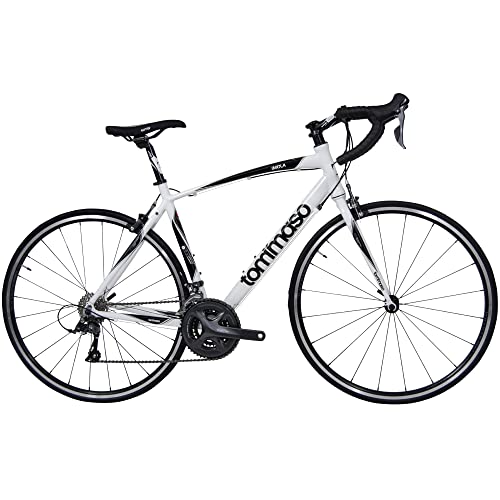
The Imola has been the go-to answer for a first Amazon-bought road bike for years, and the specification explains why. The frame is aluminum, the wheels are standard 700c, and the drivetrain is a genuine Shimano Claris R2000 setup with 24 speeds from a triple-chainring layout. That triple gives beginners an especially wide spread of gears, including a very low climbing gear, while keeping the dual-control levers that define proper road shifting.
The supporting parts are chosen sensibly rather than cheaply: Tommaso’s own TC20 wheels, Claris dual-pivot brakes, a compact handlebar that keeps the drops within easy reach, and a WTB Volt saddle — a saddle shape many riders keep for years. The size range is a real strength, running from small frames up to a 60-centimetre option that taller riders rarely find in this segment.
The Imola’s compromises are the honest ones for its tier: a steel fork instead of carbon, and rim brakes. Neither stops it being the right first bike for most people. Choose it if you want the lowest-risk entry into drop-bar riding with a drivetrain you will not outgrow in a single season.
2. Tommaso Monza — the step-up pick with Tiagra and a carbon fork
Runner-Up
2. Tommaso Monza — the step-up pick with Tiagra and a carbon fork
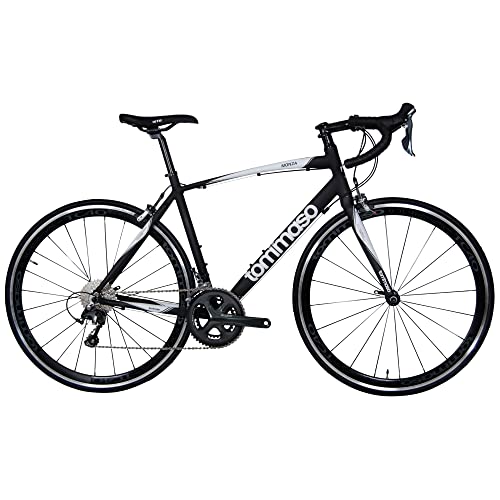
The Monza is the Imola’s more serious sibling, and it is the pick for the beginner who is fairly confident road riding will stick. The frame is aluminum again, but the fork upgrades to carbon, which noticeably calms the buzz from coarse pavement on longer rides. The drivetrain moves up to a full Shimano Tiagra groupset: two chainrings by ten speeds, with a compact 50/34 crankset and a wide 11–32 cassette, so the gearing stays beginner-friendly while the shifting takes a clear step up in precision and smoothness.
Tiagra is the sweet spot of the Shimano range for a committed beginner. The shifters feel close to the enthusiast groups, the parts are durable, and replacements are available everywhere. The Monza’s frame is also drilled for racks and fenders, which quietly makes it more versatile than a pure race-style machine — it can commute in the week and do long weekend rides without modification.
Choose the Monza if your budget reaches the upper part of this segment and you would rather buy once. Riders who start on the Monza typically upgrade wheels or contact points after a season or two, not the whole bike.
3. Tommaso Illimitate — the all-road option for mixed surfaces
3. Tommaso Illimitate — the all-road option for mixed surfaces
The Illimitate shares the Monza’s recipe — aluminum frame, carbon fork, Shimano Tiagra gearing in a 20-speed setup — but tunes it for versatility. It is sold as a gravel and road bike, which in practice means clearances and geometry that tolerate rougher surfaces than a pure road frame: chipseal lanes, hard-packed paths, and the broken back roads that pure race bikes make miserable.
For a beginner, that versatility solves a real problem. Not everyone lives beside smooth tarmac, and a first bike that only feels good on perfect pavement gets ridden less. The Illimitate keeps the drop bars, the integrated Tiagra shifting, and the efficient road position, while forgiving the surfaces your local routes actually offer. Fitted with narrower road tires it behaves as a road bike; with its standard setup it shrugs off the rough stuff.
Choose the Illimitate if your riding will mix pavement with light unpaved surfaces, or if your local roads are rough enough that comfort, not outright speed, will decide how often you ride.
How the Three Compare
All three bikes share the fundamentals that matter: aluminum frames, 700c wheels, Shimano dual-control shifting, and compact gearing with a low climbing gear. The differences are about refinement and intent.
The Imola is the value anchor, with Claris gearing and a steel fork. The Monza adds Tiagra shifting and a carbon fork for riders staying on the road and staying in the sport. The Illimitate matches the Monza’s component level but trades a little pure-road sharpness for surface versatility. A useful way to decide: buy the Imola to find out whether you love road riding, the Monza if you already know, and the Illimitate if your routes — not just your ambitions — demand flexibility.
Whichever you pick, reserve part of your overall budget for the unglamorous essentials: professional assembly, a helmet, a floor pump, a spare tube and levers, and lights if you will ride at dawn or dusk. A mid-range bike with those basics covered is a far better purchase than a fancier bike without them.
Sizing and Setup Tips for New Road Riders
Start with the manufacturer’s chart and your inseam, not just your height. When the bike arrives, have the shop set your saddle height so your knee keeps a slight bend at the bottom of the stroke, and keep the stem and bars in their standard position until you have a few weeks of riding — beginners often feel stretched at first and then adapt as flexibility and core strength build.
Keep tire pressures sensible rather than maximum: the figure printed on the sidewall is a limit, not a target, and slightly softer tires grip better and hurt less. Finally, schedule the free tune-up most shops offer after the first few weeks. Cables settle and bolts relax on any new bike; that check is routine, not a sign of a problem.
Frequently Asked Questions
Is a mid-range bike worth it over the cheapest drop-bar bikes?
For most beginners, yes. The jump buys you a genuine Shimano groupset with integrated levers, a lighter aluminum frame, standard serviceable parts, and a real size range. Those are exactly the things that decide whether a first bike gets ridden for years or abandoned in a season.
Claris or Tiagra for a first bike?
Claris is entirely sufficient to learn on and its triple-chainring version offers very low climbing gears. Tiagra shifts more precisely, spaces its ten gears more closely, and feels better for longer. If you expect to ride a lot, Tiagra is worth the step; if you are testing the sport, Claris will not hold you back.
Can I ride these bikes for commuting or light touring?
Yes, within reason. The Monza’s rack and fender mounts make it the natural commuter of the three, and all of them handle daily road miles comfortably. For loaded touring, a dedicated touring frame is a better tool, but for commuting and credit-card touring these bikes cope well.
Do I really need professional assembly?
The manufacturers say so themselves, and they tie warranty validity to it. Beyond the paperwork, a mechanic trues the wheels, sets the shifting, and torques the cockpit correctly — the difference between a bike that feels solid and one that feels vague.
Conclusion
The best beginner road bike in this segment is the one with a real Shimano drivetrain, gearing low enough for your local hills, and a size that truly fits you. The Tommaso Imola is the safest first step, the Tommaso Monza is the buy-once choice with Tiagra and a carbon fork, and the Tommaso Illimitate adds all-road versatility for mixed surfaces. Pick the one that matches your routes and commitment level, get it professionally assembled, and spend the rest of your energy where it belongs — on riding it.
9
99klik Editorial Team
We compare specs, materials and verified owner reviews before a product earns a spot. Rankings are never paid.
Affiliate disclosure. As an Amazon Associate we earn from qualifying purchases at no extra cost to you. Prices accurate as of the date shown.
Compare three home laser printers for crisp black-and-white documents, wireless printing, duplex options, scanning, and paper capacity for small spaces.
Five prebuilt gaming computers with RTX graphics, fast memory, and roomy SSDs compared side by side, so you can match a desktop to your games and desk.
Discover the best smartwatches for iPhone under 200 with long battery life, built-in GPS and health tracking for everyday fitness on iOS. Top picks compared.
Explore the best 8K video cameras for filmmakers and hybrid shooters, with full-frame sensors, RAW recording, reliable autofocus and pro codecs. Compared.
Best race bike tyres 2: a second, tubeless-ready roundup covering the Continental GP5000 S TR, Schwalbe Pro One TLE, Pirelli P Zero Race TLR and Vittoria Corsa Pro TLR.
A second-round guide to cheap bike helmets for adult everyday riders: four CPSC-certified value picks compared on fit, ventilation, and safety features, with sizing and buying advice — no prices, just value.
Looking for the best bike for wheelies? These 20-inch BMX picks offer the short rear end, strong frame and simple gearing that make learning to wheelie easier.
An informational guide to 10440 rechargeable batteries: what the size code means, lithium chemistries, voltage and capacity, compatible devices, charging, and safety — and why there is no affiliate product list here.

 1. Tommaso Imola — the default first road bike, done properly
 2. Tommaso Monza — the step-up pick with Tiagra and a carbon fork
 3. Tommaso Illimitate — the all-road option for mixed surfaces