Key takeaways
- Discover the best smartwatches for iPhone under 200 with long battery life, built-in GPS and health tracking for everyday fitness on iOS. Top picks compared.
Introduction
Finding the best smartwatches for iPhone under 200 means balancing two things that do not always go together: a tight budget ceiling and genuinely good iPhone compatibility. Apple’s own watch is the obvious pairing for an iPhone, but its list price sits above the two-hundred-dollar mark, which pushes many shoppers toward well-made third-party watches instead. The good news is that several of those alternatives pair with an iPhone through a companion app, deliver notifications to your wrist, and track workouts, sleep, and heart rate without demanding a daily charge.

This guide focuses on three smartwatches that work with iOS and fit the budget in words, not in wishful thinking: the Garmin Venu Sq 2, the Fitbit Versa 4, and the Amazfit GTR 4. Each one connects to an iPhone over Bluetooth through its maker’s app, each one has built-in GPS for phone-free run tracking, and each one lasts several days on a charge rather than a single day. None of them replaces an Apple Watch feature for feature — only Apple’s own watch offers the deepest integration with iOS — but for fitness tracking, sleep insights, and everyday notifications, all three are strong, practical choices.
Below you will find a quick comparison, a buying guide covering the factors that matter most for iPhone owners, detailed reviews of each watch, answers to common questions, and a short conclusion to help you pick the right one for your wrist and your routine.
At a Glance
| Product | Best for | Key spec |
|---|---|---|
| Garmin Venu Sq 2 | Battery life and serious fitness tracking | 1.41-inch AMOLED display, up to 11 days of battery life, 25 preloaded sports apps |
| Fitbit Versa 4 | Health and sleep tracking | 6-day battery life, built-in GPS, 40-plus exercise modes |
| Amazfit GTR 4 | Value and long battery life | 1.43-inch AMOLED display, dual-band GPS, up to 14 days of battery life |
How to Choose a Smartwatch for iPhone
iPhone compatibility comes first
A smartwatch is only useful with an iPhone if its companion app runs well on iOS and the Bluetooth connection stays stable. Garmin watches use the Garmin Connect app, Fitbit watches use the Fitbit app, and Amazfit watches use the Zepp app, and all three apps are available for iPhone. That said, some features are platform-limited: quick replies to text messages from the watch, for example, are generally an Android-only feature on third-party watches, while iPhone owners still receive notifications, calls, calendar alerts, and app alerts on their wrist. Before buying, confirm that the watch you want lists iOS support in its specifications and that you are comfortable managing settings through the companion app rather than through the iPhone’s own settings.
Battery life changes how you actually use the watch
Battery life is the single biggest practical difference between third-party watches and Apple’s own watches. The three watches in this guide last from around six days to around two weeks in smartwatch mode, which means you can wear them overnight for sleep tracking without planning your day around a charger. Longer battery life also matters for GPS workouts: a watch rated for many hours of continuous GPS tracking will handle long runs, hikes, and rides without dying mid-activity. If you dislike charging gadgets every night, treat battery life as a top priority and pay attention to how always-on display settings reduce it.
Fitness and health tracking depth
All three watches track steps, heart rate, sleep, and workouts, but they differ in depth. Garmin’s platform is known for detailed training metrics, recovery guidance, and a large library of sports profiles. Fitbit is known for sleep tracking, daily readiness scores, and Active Zone Minutes, which turn heart-rate data into a simple weekly activity goal. Amazfit covers the essentials well, with a very large number of sports modes and stress monitoring, at a lower cost. Think about what you will actually check: runners and multisport athletes tend to value Garmin’s detail, while sleep-focused buyers often prefer Fitbit’s presentation.
Display quality and readability
A bright AMOLED display is easier to read outdoors than a dimmer LCD panel, and all three watches here use AMOLED screens. Screen size matters too: a larger display shows more workout data at a glance and makes notifications easier to skim, while a smaller, lighter watch disappears on the wrist during sleep and long workouts. Consider the case size as well — a 40-millimetre-class case suits most wrists, while larger cases can feel bulky on smaller wrists.
Water resistance and build
If you swim, shower, or train outdoors in all weather, look for a watch rated for swimming and built to shrug off sweat and rain. All three watches in this guide are designed for swim and shower use, with durable glass and silicone bands suited to workouts. A stainless-steel or aluminium bezel resists scratches better than a plain plastic case, which matters if the watch will be worn every day.
Staying inside the budget
The ceiling for this guide is two hundred dollars, and all three picks sit at or below that level at typical retail. Sales and seasonal promotions can move individual models further below the ceiling, but the ceiling itself is the point: you do not need to stretch beyond it to get GPS, multi-day battery life, and solid health tracking. Keep the budget firm, compare the features above, and choose based on which strengths match your routine rather than on brand alone.
Product Reviews
Garmin Venu Sq 2
The Garmin Venu Sq 2 is the fitness-first pick in this guide, and its headline strength is battery life: up to 11 days in smartwatch mode and up to 26 hours with continuous GPS, according to Garmin’s specifications. That kind of endurance means you can track a full week of workouts and sleep without reaching for the charger, which is a meaningful quality-of-life difference for anyone who trains regularly. The square case measures 40.6 by 37.0 by 11.1 millimetres, weighs 38 grams, and carries a 1.41-inch AMOLED display with a 320 by 360 resolution, protected by Gorilla Glass 3 with an aluminium bezel and silicone band.
Inside, the watch offers 25 preloaded sports apps covering running, cycling, strength, cardio, HIIT, swimming, and more, along with wrist-based heart rate, sleep score, stress tracking, and Garmin’s Body Battery energy monitoring, which estimates how recovered you are based on sleep, stress, and activity. Built-in GPS means you can leave the phone at home on runs, and smart notifications deliver calls and texts to your wrist when paired with an iPhone or Android phone. The watch stores 4 GB of memory and connects over Bluetooth and Wi-Fi, with a model number of 010-02701-00 in the Slate aluminium bezel with Shadow Gray case reviewed here.
The Venu Sq 2 is best for iPhone owners who train several times a week and want detailed fitness data without daily charging. Its limitations are modest but real: its smart features are not as deep as those on Apple’s own watch, quick replies to messages are limited to Android, and it lacks the premium materials and animated on-screen workouts found on higher-end Garmin models. One availability note: Garmin’s own website now lists the Venu Sq 2 as discontinued, so buyers should check the listing carefully and confirm the exact variant before ordering.
Pros:
– Up to 11 days of battery life in smartwatch mode
– Bright 1.41-inch AMOLED display with Gorilla Glass 3
– 25 preloaded sports apps and detailed recovery metrics
– Built-in GPS for phone-free workout tracking
– Lightweight 38-gram case that is comfortable overnight
Cons:
– Garmin’s site now marks this model as discontinued, so availability may vary
– Smart features are more limited than on Apple’s own watch
– Quick replies to texts are not available when paired with an iPhone
– No onboard music storage on the standard edition
Fitbit Versa 4
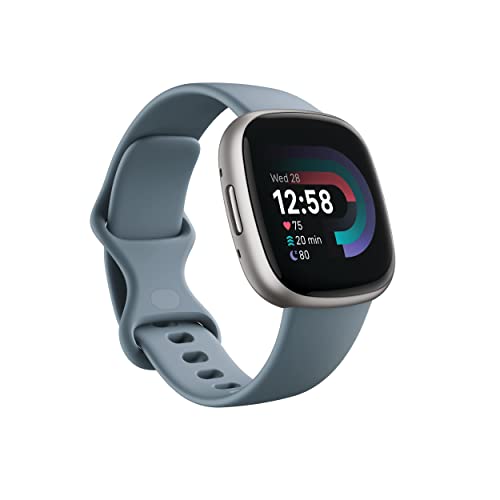
The Fitbit Versa 4 is the health-and-sleep pick in this guide. Its headline figures are a battery life of up to six days, built-in GPS, and more than 40 exercise modes, wrapped around a 1.58-inch AMOLED display. The model number is 6514031, and the Waterfall Blue and Platinum colourway ships with both small and large bands in the box, so most wrists are covered without buying an extra strap. The watch tracks heart rate around the clock, monitors sleep stages and sleep score, and offers a Daily Readiness score that combines sleep, activity, and heart-rate variability into a single suggestion about how hard to train on a given day.
For iPhone owners, the Versa 4 pairs through the Fitbit app, which remains one of the clearest health dashboards on iOS, with simple charts for steps, sleep, resting heart rate, and Active Zone Minutes. Built-in GPS records pace and distance on outdoor runs without the phone, and the watch supports Google Maps directions and Google Wallet, reflecting Fitbit’s place inside Google’s ecosystem. Setup requires a Google account, which is worth knowing before buying. The Versa 4 is water resistant for swimming and showering, and its lightweight design makes it easy to wear overnight, which matters because its best insights come from sleep data.
The Versa 4 is best for buyers who care most about sleep, daily health trends, and a friendly app rather than deep training analytics. Its limits are that its GPS accuracy and sports depth sit a step behind Garmin’s, its battery life is the shortest of the three watches here at around six days, and some advanced insights sit behind Fitbit’s optional Premium subscription. Even so, for everyday health tracking on an iPhone, it is a polished and dependable choice.
Pros:
– Up to six days of battery life with built-in GPS
– Strong sleep tracking and Daily Readiness score
– Clear, beginner-friendly Fitbit app on iOS
– More than 40 exercise modes with heart-rate tracking
– Two band sizes included in the box
Cons:
– Sports and GPS depth trail the Garmin Venu Sq 2
– Some advanced insights require an optional Premium subscription
– Setup requires a Google account
– Six-day battery life is the shortest of the three picks here
Amazfit GTR 4
The Amazfit GTR 4 is the value pick in this guide, and it makes a strong case that a lower cost does not have to mean a weaker watch. Its headline figures are a battery life of up to 14 days with typical use, a 1.43-inch round AMOLED display, dual-band GPS, and more than 150 sports modes, all in a stainless-steel body that looks more expensive than it is. The watch pairs with an iPhone through the Zepp app, which handles settings, watch faces, health data, and firmware updates, and it includes 2.3 GB of onboard music storage so you can copy songs to the watch and listen through Bluetooth earphones without carrying a phone.
Dual-band GPS is a notable feature at this level: by receiving signals on two frequencies, the watch can hold a more accurate position in cities, forests, and other tricky environments, which shows up as cleaner route maps after outdoor runs and rides. Health tracking covers heart rate, blood oxygen, stress, and sleep, and the round display suits buyers who prefer a traditional watch look rather than a square smartwatch shape. The GTR 4 is also well suited to travellers and busy users who simply do not want to think about charging, since two weeks of battery life covers a long trip without a cable.
The GTR 4 is best for iPhone owners who want the longest battery life and the most sports modes for the least money, and who are happy managing the watch through the Zepp app. Its limits are that its app ecosystem and third-party integrations are thinner than Garmin’s or Fitbit’s, its health metrics are estimates rather than medical measurements, and its notification handling is solid but basic compared with Apple’s own watch. For the budget, though, its combination of display, GPS, battery life, and build quality is hard to beat.
Pros:
– Up to 14 days of battery life with typical use
– Dual-band GPS for more accurate route tracking
– More than 150 sports modes in a stainless-steel body
– Onboard music storage for phone-free listening
– Round AMOLED display with a classic watch look
Cons:
– App ecosystem is thinner than Garmin Connect or the Fitbit app
– Health metrics are estimates, not medical measurements
– Notification handling is functional but basic
– Zepp app setup takes a little patience the first time
Comparison: Which One Fits You
Choose the Garmin Venu Sq 2 if training data and battery life matter most. Its 11-day battery, 25 sports apps, and recovery metrics make it the strongest companion for runners, gym-goers, and multisport athletes who want detailed feedback and rarely want to charge. Just note that Garmin has marked the model as discontinued on its own site, so confirm the listing before ordering.
Choose the Fitbit Versa 4 if sleep and everyday health trends are your priority. Its Daily Readiness score, sleep tracking, and clear iOS app make health data easy to understand at a glance, and six days of battery life is still far better than a daily charge. It is the most approachable of the three for first-time smartwatch buyers.
Choose the Amazfit GTR 4 if you want the most features for the least money and the longest time between charges. Fourteen days of battery, dual-band GPS, more than 150 sports modes, and music storage in a steel body cover almost every everyday need, and the round design looks at home anywhere from the gym to the office.
All three pair with an iPhone, all three have built-in GPS, and all three sit within the two-hundred-dollar ceiling. The right choice depends on whether you value training depth, health presentation, or sheer battery life and value most.
Frequently Asked Questions
Do these smartwatches work with an iPhone?
Yes. The Garmin Venu Sq 2 pairs through the Garmin Connect app, the Fitbit Versa 4 through the Fitbit app, and the Amazfit GTR 4 through the Zepp app, and all three apps run on iOS. You will receive call, text, calendar, and app notifications on your wrist, though quick replies to messages are generally limited to Android phones on third-party watches.
Is the Apple Watch SE the better choice for iPhone owners?
Apple’s own watch offers the deepest integration with iOS, including tighter notification handling, Apple Pay, and seamless pairing, so it is the natural first choice for many iPhone owners. However, its list price sits above the two-hundred-dollar ceiling used in this guide, and its battery life is around a day, so buyers who want multi-day battery and a lower cost often prefer the watches reviewed here.
Which watch has the longest battery life?
The Amazfit GTR 4 leads with up to 14 days of battery life with typical use, followed by the Garmin Venu Sq 2 at up to 11 days in smartwatch mode, and the Fitbit Versa 4 at up to six days. Using always-on display mode or frequent GPS workouts reduces battery life on all three, so treat the headline figures as typical-use estimates.
Can I track runs without carrying my iPhone?
Yes. All three watches have built-in GPS, so they can record pace, distance, and route on outdoor runs, rides, and walks without a phone nearby. Your workout data syncs to the companion app on your iPhone when the watch reconnects over Bluetooth.
Are these watches suitable for swimming?
All three are designed for swim and shower use, with water resistance suited to pool swimming and everyday splashes. Rinse the watch with fresh water after swimming in a pool or the sea, and check the manufacturer’s guidance before using it for diving or high-speed water sports.
Do I need a subscription to use these watches?
No subscription is required for core features such as step counting, heart-rate tracking, sleep monitoring, GPS workouts, and notifications on any of the three watches. Fitbit offers an optional Premium subscription that adds deeper insights and guided programs, but the Versa 4 works fully without it.
Conclusion
The best smartwatches for iPhone under 200 do not ask you to choose between a good price and a good experience. The Garmin Venu Sq 2 suits regular trainers who want deep fitness data and 11-day battery life, the Fitbit Versa 4 suits buyers who want clear sleep and health insights in a friendly app, and the Amazfit GTR 4 suits anyone who wants two weeks of battery, dual-band GPS, and a steel body at a value price. Pick the strength that matches your routine, pair the watch with its iPhone app, and you will have a capable everyday companion without crossing the two-hundred-dollar ceiling.
Disclosure: As an Amazon Associate, we earn from qualifying purchases.