We independently review everything we recommend. When you buy through our links, we may earn a commission. As an Amazon Associate we earn from qualifying purchases.
Does RV Battery Work Directly Offf Batery or Throungh Nverter
Does RV battery work directly offf batery or throungh nverter? DC loads run off the battery; AC loads need an inverter. See five 12V 100Ah RV batteries.
Does RV battery work directly offf batery or throungh nverter? DC loads run off the battery; AC loads need an inverter. See five 12V 100Ah RV batteries.
Disclosure: As an Amazon Associate, this site may earn from qualifying purchases made through links on this page.
OUR TOP PICK
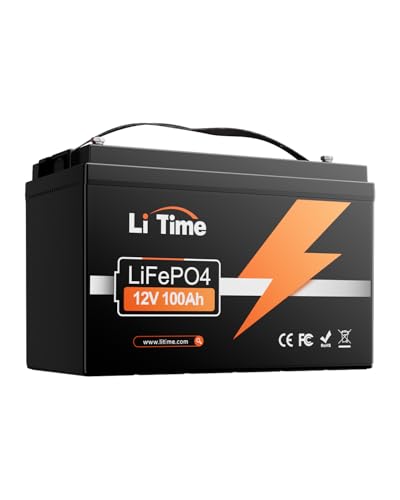
LiTime 12V 100Ah Group 31 LiFePO4 Deep Cycle Battery
The short answer is both, and the split depends on what the load needs. The keyword here is written with typos; the intended wording is “does RV battery work directly off battery or through inverter”. An RV battery stores 12-volt direct current, called DC. Loads that run on 12-volt DC draw straight from the battery with no inverter in between: ceiling lights, vent fans, the water pump, the furnace fan, slide-out motors, and the control boards for the fridge and water heater. Loads that need household alternating current, called AC, cannot run straight off the battery. Wall outlets, the microwave, the air conditioner, and a television plugged into a household outlet all need an inverter, which converts the battery’s 12-volt DC into 120-volt AC.
That split is the whole design of an RV electrical system. The battery is the DC source. The inverter is the bridge to AC. When the RV is plugged into shore power at a campground, a converter does the reverse job: it turns 120-volt AC from the pedestal into 12-volt DC to run the DC loads and recharge the battery. Nothing about this is a matter of opinion or a practical result; it is how RV power systems are wired. The five batteries below are all 12-volt, 100-amp-hour lithium iron phosphate deep-cycle batteries made for RV use, and each one is the kind of battery that sits at the center of the system described here.
At a Glance
LiTime Group 31 (B084DB36KW): 12-volt, 100Ah, 100-amp BMS, 22.05 pounds, Group 31 size, five-year warranty, no Bluetooth.
ECO-WORTHY Group 24 (B09L89LW3P): 12-volt, 100Ah, Bluetooth 5.1 monitoring, low-temperature cut-off, 23.15 pounds, three-year warranty.
Dumfume Group 31 (B0F4MJKYXC): 12-volt, 100Ah, 100-amp BMS, 21.6 pounds, five-year warranty, charging needs 5 degrees Celsius or higher.
LiTime Group 27 (B0DYV1FKH5): 12-volt, 100Ah, Bluetooth 5.0, 100-amp BMS, low-temperature cut-off, 22.9 pounds, five-year warranty, sized for Group 27 compartments.
How to Choose
Capacity first. All five picks hold 100 amp-hours at 12 volts, which is 1280 watt-hours of stored energy each. That is a common single-battery size for a travel trailer or small motorhome. Two batteries wired in parallel double the stored energy; four in series-parallel builds a larger bank. Check how much space the battery compartment holds before adding a second unit.
Chemistry matters. These five are lithium iron phosphate, known as LiFePO4. Compared with a lead-acid deep-cycle battery of the same amp-hour figure, a LiFePO4 battery weighs about a third as much, holds its voltage steady as it drains, and can be used through far more charge cycles. The trade-off is cold: most LiFePO4 cells must not be charged below freezing, and the picks below handle that in different ways.
Group size is a physical fit. Group 24, Group 27 and Group 31 are standard battery case sizes. A Group 31 case is longer than a Group 24 case. Measure the compartment, the tray, and the hold-down before ordering. A battery that does not fit the tray is a return, not a solution.
Built-in BMS. Every pick here has a built-in battery management system rated at 100 amps. The BMS guards against overcharge, over-discharge, over-current, short circuit and overheating. A 100-amp BMS also sets the ceiling on continuous draw: a single battery can feed a 1000-watt inverter load with headroom, but a larger inverter needs more than one battery in parallel.
Low-temperature protection. This is the detail that separates the picks. Some cut off charging below freezing and resume when the cell warms. Others state no low-temperature cut-off at all, which means the owner must keep the battery warm or skip charging on cold mornings. Read the pick notes before deciding.
Deep-cycle only. None of these five is a cranking battery. They are not made to crank an engine, run a golf cart, or power a jack. They are made to run RV house loads for hours: lights, fans, pumps, and an inverter feeding AC appliances.
Terminals and weight. All five use M8 terminals. Weights run from 21.6 to 23.15 pounds, light enough for one person to lift into a compartment. Compare that with a lead-acid battery of the same capacity, which the Dumfume listing puts near 64 pounds.
The Picks
1. LiTime 12V 100Ah Group 31 LiFePO4 Deep Cycle Battery
Top Pick
1. LiTime 12V 100Ah Group 31 LiFePO4 Deep Cycle Battery
The LiTime Group 31 is the plain workhorse of the five. It is a 12-volt, 100-amp-hour LiFePO4 battery with a built-in 100-amp BMS, M8 terminals, and a Group 31 case measuring 13 by 6.77 by 8.5 inches at 22.05 pounds. The listing states up to 15000 cycles when the battery is cycled to six tenths of its capacity, an IP65 waterproof mark, and support for up to four in parallel and four in series. The maker gives a five-year warranty. There is no Bluetooth on this version, so state of charge is read from a meter or the inverter display rather than a phone. The listing is explicit that this battery is not for cranking engines. It is the pick for an owner who wants a known brand, a Group 31 fit, and no extra electronics to manage.
2. ECO-WORTHY 12V 100Ah LiFePO4 Battery with Bluetooth, Group 24
Runner-Up
2. ECO-WORTHY 12V 100Ah LiFePO4 Battery with Bluetooth, Group 24
The ECO-WORTHY pick adds phone monitoring to the same 12-volt, 100-amp-hour base. Bluetooth 5.1 shows voltage, current and remaining capacity from a phone app, and the battery is a Group 24 case at 10.23 by 6.6 by 8.43 inches and 23.15 pounds. The built-in 100-amp BMS uses automotive-grade cells, and the listing states low-temperature cut-off protection that stops charging when the cell temperature falls below minus 7 degrees Celsius. The maker gives a three-year warranty, shorter than the five years on the other picks here. The Group 24 case is the smallest of the five, which helps in tight compartments. This is the pick for an owner who wants to watch the battery from a phone and needs the smallest case.
3. Dumfume 12V 100Ah LiFePO4 Lithium Battery, Group 31
3. Dumfume 12V 100Ah LiFePO4 Lithium Battery, Group 31
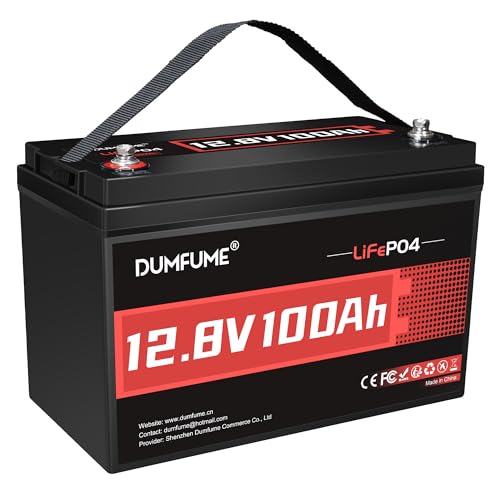
The Dumfume Group 31 is the lowest-weight pick here at 21.6 pounds, in a case measuring 13 by 6.69 by 8.62 inches, with a built-in 100-amp BMS and 1280 watt-hours of stored energy. The listing states over 15000 cycles and a five-year warranty, and describes the battery as a drop-in replacement for a lead-acid 12-volt battery with no extra wiring needed. Two limits need stating plainly. First, the ABS casing is dustproof and weather resistant but not waterproof, unlike the IP65 mark on the LiTime and Dyness picks. Second, the listing states battery performance requires temperatures of 5 degrees Celsius or higher, and that return shipping for low-temperature charging issues is not covered. That makes this pick a fair-weather choice: strong on weight and warranty, weaker on cold mornings than the ECO-WORTHY or Dyness picks.
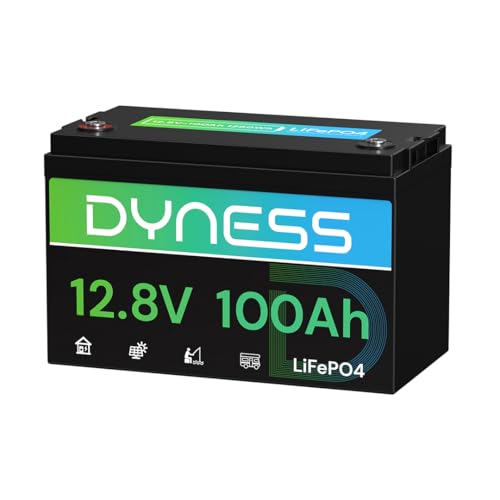
The Dyness G31 pairs a 100-amp BMS with A-plus grade cells in a Group 31 case measuring 13.0 by 6.77 by 8.43 inches at 21.8 pounds. The listing states low-temperature charging protection that disconnects charging below 32 degrees Fahrenheit and resumes at 41 degrees Fahrenheit, plus dust resistance, salt-spray resistance and an IP65 waterproof mark. The maker gives a five-year warranty and a lifespan of up to 10 years. The listing also recommends a LiFePO4-specific charger for the quickest and safest full charge, and recharging at 0.2C for best battery health. Up to four in series and four in parallel are supported, building a bank of up to 20.48 kilowatt-hours. This is the pick for an owner who camps in cold weather and wants the low-temperature cut-off spelled out with exact figures.
5. LiTime 12V 100Ah LiFePO4 Battery, Group 27, with Bluetooth
5. LiTime 12V 100Ah LiFePO4 Battery, Group 27, with Bluetooth
The second LiTime pick is a different model from the first: a Group 27 case with Bluetooth 5.0 monitoring through the LiTime app, a 100-amp BMS with over 20 protections including low-temperature cut-off, and an IP65 waterproof mark. It holds 100 amp-hours at 12.8 volts, weighs 22.9 pounds, and measures 13.11 by 6.97 by 8.5 inches. The listing names specific RVs the Group 27 case is tailored for, including Brinkley, Four Winds and Forest River models, and states the battery is not for cranking, golf carts, or jacks. The maker gives a five-year warranty. Buy one LiTime or the other, not both: the Group 31 pick is the no-Bluetooth workhorse, while this Group 27 pick is the Bluetooth model in the smaller case. The Group 27 size also fits compartments where a Group 31 case is too long.
Comparison Table
Pick
Size
Bluetooth
Weight
Low-temperature charging
Warranty
LiTime Group 31
Group 31
No
22.05 lb
Not stated on listing
5 years
ECO-WORTHY Group 24
Group 24
Yes, 5.1
23.15 lb
Cut-off below minus 7 C
3 years
Dumfume Group 31
Group 31
No
21.6 lb
Needs 5 C or higher
5 years
Dyness G31
Group 31
No
21.8 lb
Cut-off below 32 F, resume 41 F
5 years
LiTime Group 27
Group 27
Yes, 5.0
22.9 lb
Cut-off stated
5 years
Which One Fits Your Situation
Plain Group 31 fit, no phone app needed: the LiTime Group 31, with a five-year warranty and an IP65 waterproof mark.
Smallest case and phone monitoring: the ECO-WORTHY Group 24, keeping in mind the three-year warranty is the briefest here.
Lowest-weight battery and a five-year warranty: the Dumfume Group 31, for fair-weather camping where charging stays above 5 degrees Celsius.
Cold-weather camping with exact cut-off figures: the Dyness G31, with low-temperature protection spelled out in Fahrenheit.
Group 27 compartment and Bluetooth monitoring: the LiTime Group 27, the Bluetooth model in the smaller case.
FAQ
Does an RV battery work directly off the battery or through an inverter?
Both. Twelve-volt DC loads such as lights, fans, the water pump and slide motors run directly off the battery. Household AC loads such as wall outlets, the microwave and the air conditioner run through an inverter that converts 12-volt DC into 120-volt AC. The battery never feeds a wall outlet directly.
Can an RV battery run the air conditioner?
Only through an inverter, and only briefly on a single 100-amp-hour battery. An air conditioner draws far more than a single battery and a small inverter can sustain. Owners who run air conditioning off batteries use large banks and large inverters, or run the air conditioner from shore power or a generator.
Does the RV battery charge while driving?
In most motorhomes, yes: the engine alternator charges the house battery through an isolator or a DC-to-DC charger while driving. In a travel trailer, the tow vehicle charges the battery through the seven-pin connector, though the charge current is modest. A converter charges the battery from shore power at a campground.
What size inverter does a 100Ah battery support?
A single 100-amp-hour LiFePO4 battery with a 100-amp BMS can feed a 1000-watt inverter with headroom. A 2000-watt inverter needs two batteries in parallel so the draw stays within each BMS limit. Check the inverter manual and the battery BMS figure before pairing them.
Why does my RV battery drain overnight with nothing on?
Small draws add up: the propane detector, the stereo memory, the control boards, and the inverter itself in standby all draw power around the clock. An inverter left on with no load still draws current. Switching the inverter off when AC loads are not needed stops the largest idle draw.
Final Take
An RV battery works directly off the battery for 12-volt DC loads and through an inverter for 120-volt AC loads. That split decides what the battery can run and what it cannot. A single 12-volt, 100-amp-hour LiFePO4 battery covers lights, fans, pumps and modest inverter loads; larger AC loads need a bigger bank. Among the five picks, the LiTime Group 31 is the plain fit, the Dyness G31 is the cold-weather pick, and the ECO-WORTHY Group 24 is the smallest case with phone monitoring. Measure the compartment, confirm the group size, and confirm the low-temperature charging behavior before ordering, since those three details decide whether the battery fits the RV and the climate it camps in.
9
99klik Editorial Team
We compare specs, materials and verified owner reviews before a product earns a spot. Rankings are never paid.
Affiliate disclosure. As an Amazon Associate we earn from qualifying purchases at no extra cost to you. Prices accurate as of the date shown.
Galaxy Z Flip vs Galaxy S20 Ultra compared on display, cameras, battery and size, with five Amazon Renewed picks to help you choose the right 2020 Samsung.
Best Japanese vegetable cleaver guide: five nakiri knives compared on steel, edge angle, handle and weight, so you can pick the right one for produce prep.
What is a UPS battery? It is the sealed lead-acid battery inside a UPS that keeps devices running during an outage. See how it works and the best 12V 9Ah picks.
Can one replace the battery in a t900 tablet? Yes — the Galaxy Tab Pro 12.2 SM-T900 uses a 9500mAh cell. See five replacement kits and what the swap involves.
The best metals for earth battery builds are copper, magnesium, and aluminum-zinc. Compare voltage pairs and forms, and how long each metal lasts in soil.
Best THC batteries nectar collector picks: three 510-thread batteries with adjustable voltage, USB-C charging, and LED displays for standard attachments.

 1. LiTime 12V 100Ah Group 31 LiFePO4 Deep Cycle Battery
 2. ECO-WORTHY 12V 100Ah LiFePO4 Battery with Bluetooth, Group 24
 3. Dumfume 12V 100Ah LiFePO4 Lithium Battery, Group 31
 4. Dyness 12V 100Ah LiFePO4 Lithium Battery G31
 5. LiTime 12V 100Ah LiFePO4 Battery, Group 27, with Bluetooth