We independently review everything we recommend. When you buy through our links, we may earn a commission. As an Amazon Associate we earn from qualifying purchases.
Best Air Purifiers for 1000 Sq Ft: 5 Large-Room Picks With Published Coverage
Five air purifiers whose makers publish coverage beyond 1,000 sq ft, compared on CADR, AHAM room size, filter design, noise, power draw and smart controls.
Five air purifiers whose makers publish coverage beyond 1,000 sq ft, compared on CADR, AHAM room size, filter design, noise, power draw and smart controls.
As an Amazon Associate, we earn from qualifying purchases made through links on this page.
A 1,000 sq ft space — a great room, an open-plan main floor, a finished basement — sits at the edge of what a single portable air purifier can handle. It is also where product pages get confusing, because two different sizing systems appear side by side. AHAM, the appliance makers’ association, publishes a room size for each verified model using its two-thirds rule: the smoke CADR should equal at least two-thirds of the room’s square footage, which works out to about 4.8 air changes per hour with an 8-foot ceiling. Makers also publish a maximum coverage figure, usually measured at one or two air changes per hour, and that number is always far larger.
Every pick below is a purifier whose maker publishes coverage that reaches or passes 1,000 sq ft, and each section states which basis the claim rests on. Read the two numbers together: the AHAM room size tells you where the machine cleans at full allergy-grade speed, and the maker figure tells you the largest space it can turn over at a slower cadence. In a room of exactly 1,000 sq ft, these five machines deliver roughly two and a half to five air changes per hour on their top speeds — a meaningful range, and the single most useful way to compare them.
What to look for
CADR and the two-thirds rule. CADR (Clean Air Delivery Rate) is measured in cubic feet per minute for smoke, dust and pollen. Smoke is the figure to size by, because smoke particles are the hardest to capture. AHAM’s two-thirds rule says a room of 1,000 sq ft wants a smoke CADR near 667 CFM to hold 4.8 air changes per hour. Almost no portable unit reaches that, which is why honest sizing matters: a 400 CFM machine in a 1,000 sq ft room gives you about three air changes per hour — still useful for pollen, dust and pet dander control, but slower to knock down a smoke event.
Air changes per hour (ACH). This is the bridge between the two sizing systems. A coverage claim without an ACH basis is incomplete. When a maker says a unit covers 3,000 sq ft, ask at how many air changes per hour; the answer is usually one. Coway is the exception in this group, publishing its headline figure at two air changes per hour.
Filtration path. Most large-room units use True HEPA media plus activated carbon. Blueair’s HEPASilent design instead combines electrostatic charging with mechanical filtration, which moves more air with less noise and power, but it is not a sealed True HEPA path — a real consideration if a clinician has specified True HEPA. Carbon quantity matters for odors and smoke smell; thin carbon sheets saturate faster than deep carbon beds or combined cartridges.
Filter upkeep format. Large machines feed on large filters, and the formats differ: a single combined cartridge (Levoit, Blueair), two matched filter sets (Medify, Coway), or a HEPA filter plus separate carbon sheets on a shorter replacement cycle (Winix). Check the format, not just the interval, because it decides how much maintenance a big room actually creates.
Noise, sensors and placement. CADR figures are quoted at top speed, and top speed is loud on every machine here. A particle sensor with a genuine auto mode lets the unit run hard only when the air needs it. Placement matters at this scale too: keep the intake clear of walls and furniture, and put the machine near the middle of the open space rather than in a corner.
The MA-112 is the coverage heavyweight of this group, and the only pick whose maker publishes a 1,000 sq ft figure at a high air-change rate. Medify figures the MA-112 at 1,000 sq ft with five air changes per hour, 2,500 sq ft at two air changes per hour, and up to 5,948 sq ft turned over in one hour. Its published CADR is 950 cubic meters per hour, the highest maker figure here, produced by a dual-intake layout that pulls air through two filter sets at once.
Each side carries a three-stage stack: a pre-filter, an H13 True HEPA filter and an activated carbon filter, aimed at smoke, wildfire haze, pollen, pet dander and odors. Controls are on a touch panel with four fan speeds, a timer that runs up to eight hours, a filter replacement indicator and a child lock. The cabinet measures about 15.7 by 15.4 by 28.3 inches.
Who it fits: open-plan floors, large living rooms and smoke-prone regions where raw air volume matters more than quiet running or smart features.
Limitations to weigh: at 33.5 pounds it is the heaviest unit here, the top speed is loud at around 70 dB, and it draws 95 watts at full power. There is no app control, and the dual filter sets mean replacements come in pairs.
Blueair publishes the most complete numbers of any maker in this group. AHAM verifies the 211i Max at 435 CFM smoke CADR, 453 for dust and 450 for pollen, giving an AHAM room size of 674 sq ft at 4.8 air changes per hour. Blueair’s own figures say it cleans that 674 sq ft room every 12.5 minutes and can turn over up to 3,235 sq ft in one hour. In a 1,000 sq ft room, the CADR works out to roughly 3.3 air changes per hour.
The HEPASilent system charges particles electrostatically before they reach a combined particle and carbon filter, behind a washable fabric pre-filter that wraps the base. Blueair states the system captures 99.97 percent of airborne particles down to 0.1 microns. Three sensors track PM1, PM2.5 and PM10 and drive an auto mode; the Blueair app adds schedules, a night mode and filter-life tracking based on actual use, with a filter life of up to nine months. It is notably frugal and quiet for its output: 46 watts, and 23 dB on the lowest setting rising to 53 dB on high. The unit stands 22.7 inches tall and weighs 16.2 pounds.
Who it fits: allergy households and pet owners who want the strongest verified CADR in a quiet, low-power package with real sensor automation.
Limitations to weigh: HEPASilent is an electrostatic-mechanical hybrid, not True HEPA, which may rule it out where True HEPA has been specified. The combined filter is a single proprietary cartridge, and heavy smoke work calls for the maker’s carbon-heavier filter variant.
The Core 600S is the smart-feature pick. AHAM verifies it at 391 CFM smoke CADR, 398 for dust and 436 for pollen, for an AHAM room size of 606 sq ft. Levoit’s own published figures say it cleans 635 sq ft in about 12 minutes, handles 1,588 sq ft at two air changes per hour, and turns over up to 3,175 sq ft in one hour. At 1,000 sq ft, expect roughly 2.9 air changes per hour on the top setting.
A laser particle sensor shows a numeric PM2.5 reading on the unit and feeds an auto mode that adjusts fan speed to conditions; the VeSync app adds schedules and works with Alexa and Google Assistant. Filtration is a three-in-one cartridge combining a washable pre-filter, a HEPA filter and an activated carbon layer, with a stated life of six to twelve months. At 13.7 pounds and a 12.3-inch square footprint, it is the lightest and narrowest machine here, and it draws 49 watts. Noise runs from 26 dB in sleep mode to 55 dB at full speed.
Who it fits: connected homes that want live air-quality numbers, app scheduling and voice control in a unit light enough to move between floors.
Limitations to weigh: the three layers are bonded into one cartridge, so the whole filter is replaced when any layer is spent. The top speed is plainly audible, and its AHAM room size is the second smallest in this group despite the large headline coverage figure.
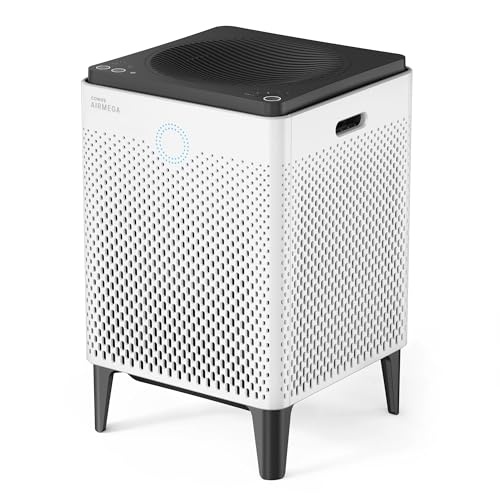
Coway publishes the most conservative headline in this group, and that is a point in its favor. The Airmega 400 is figured at 1,560 sq ft with two air changes per hour — a stricter basis than the one-air-change headlines elsewhere — and 3,120 sq ft at one air change per hour. Coway publishes a CADR of 328 CFM for smoke, 328 for dust and 400 for pollen for this series, so in a 1,000 sq ft room it delivers roughly two and a half air changes per hour.
The design draws air in through both sides, each with a washable pre-filter and a Max2 filter set that combines True HEPA media with activated carbon. A light ring on the front shows current air quality at a glance, and the controls include auto, eco and sleep modes plus a timer and a filter replacement indicator. It is a substantial piece of furniture at 14.8 by 14.8 by 22.8 inches and about 24.6 pounds, and a quiet one, running from 22 dB to 52 dB.
Who it fits: buyers who want dual-sided True HEPA filtration, a glanceable air-quality display and a coverage claim stated on a conservative basis.
Limitations to weigh: its CADR is the lowest here, so it is the slowest of the five to recover a full 1,000 sq ft room after a smoke or cooking event. Two Max2 filter sets need replacing rather than one, and this version has no Wi-Fi app — app control belongs to its sibling, the Airmega 400S.
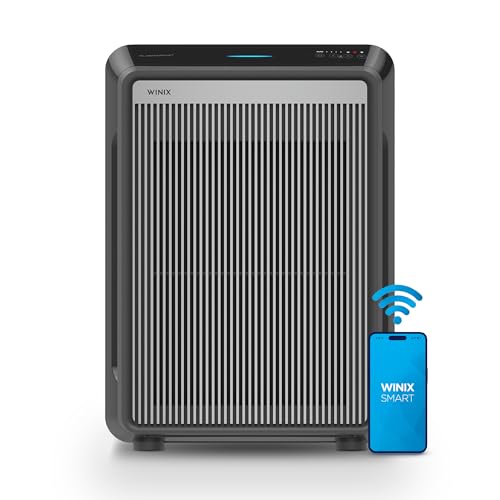
The Winix 9800 is the odor-focused pick. AHAM verifies it at 337 CFM smoke CADR, 340 for dust and 395 for pollen, an AHAM room size of 522 sq ft. Winix figures the 9800 to clean rooms up to 2,506 sq ft in one hour, which is a one-air-change basis; at 1,000 sq ft its CADR works out to roughly 2.5 air changes per hour.
Its four-stage path runs a washable mesh pre-filter, a True HEPA filter and activated carbon fabric sheets, followed by PlasmaWave, a switchable feature that generates positive and negative ions to act on airborne particles and odors. The separate carbon sheets are the point: they give it more carbon surface than the thin layers in most combined cartridges, which suits kitchens and pet households. A particle sensor drives auto and sleep modes, the display shows air quality as a color light and a numeric readout, and the Winix Smart app adds remote control and filter-life tracking. It weighs 18.7 pounds, measures 16.5 by 11.8 by 23.2 inches, and runs as low as 26.2 dB.
Who it fits: pet owners and cooks whose main problem is lingering odor in a large shared space, and who want app control.
Limitations to weigh: the carbon sheets sit on a roughly three-month replacement cycle while the HEPA filter lasts about a year, so upkeep is more frequent. PlasmaWave is an ionizing feature; it can be switched off, and households that prefer filtration only should plan to leave it off.
Comparison table
Model
Smoke CADR
AHAM room size
Maker coverage figure and basis
Filtration
Noise
Medify MA-112
950 m³/h (maker figure)
Not AHAM listed
1,000 sq ft at 5 ACH; 2,500 sq ft at 2 ACH
Dual H13 True HEPA sets with carbon
Up to about 70 dB
Blueair Blue Pure 211i Max
435 CFM (AHAM)
674 sq ft
Up to 3,235 sq ft in 1 hour (1 ACH)
HEPASilent particle and carbon cartridge
23–53 dB
Levoit Core 600S
391 CFM (AHAM)
606 sq ft
Up to 3,175 sq ft in 1 hour (1 ACH); 1,588 sq ft at 2 ACH
3-in-1 cartridge: pre-filter, HEPA, carbon
26–55 dB
Coway Airmega 400
328 CFM (maker figure)
Not stated by AHAM
1,560 sq ft at 2 ACH; 3,120 sq ft at 1 ACH
Dual Max2 True HEPA sets with carbon
22–52 dB
Winix 9800
337 CFM (AHAM)
522 sq ft
Up to 2,506 sq ft in 1 hour (1 ACH)
True HEPA plus carbon sheets, PlasmaWave
From 26.2 dB
FAQ
Can one air purifier really clean a 1,000 sq ft room?
Yes, with a caveat about speed. Every machine here is figured by its maker to cover 1,000 sq ft or more, but at that size they deliver between roughly two and a half and five air changes per hour rather than the 4.8 changes AHAM uses for its room sizes. For everyday dust, pollen and dander control that is generally workable; for fast smoke clearing, the higher-CADR models have a clear edge.
What CADR should I look for at 1,000 sq ft?
AHAM’s two-thirds rule points to a smoke CADR of about 667 CFM for full-speed cleaning at that size, which almost no portable unit reaches. A more practical reading: 400 CFM and above gives around three air changes per hour, and each step down in CADR stretches recovery time after cooking, vacuuming or a smoky day outside.
Why do maker coverage claims run so much larger than AHAM room sizes?
They measure different things. AHAM room size assumes about 4.8 air changes per hour. Most maker maximums assume one air change per hour, and a few, like Coway’s headline figure for the Airmega 400, assume two. Divide a maker’s one-hour coverage claim by about five to get a rough AHAM-equivalent room size.
Where should a large-room purifier be placed?
Near the center of the open space, with clear space around the intake and outlet, away from corners and soft furnishings that block airflow. In an open-plan floor, placing it between the kitchen and the seating area usually serves both zones better than tucking it at either end.
How much filter upkeep does a 1,000 sq ft room create?
It depends on format. Single cartridges (Blueair, Levoit) are one swap every six to twelve months by maker figures. Dual-set machines (Medify, Coway) need two sets at each change. The Winix splits its schedule: carbon sheets roughly every three months, HEPA about yearly. Heavy pet hair shortens every interval, so a washable pre-filter is worth having.
Conclusion
For a true 1,000 sq ft workload, begin with the Medify MA-112 if maximum air volume is the priority — it is the only unit here whose maker publishes 1,000 sq ft at five air changes per hour. The Blueair Blue Pure 211i Max is the strongest verified all-rounder, pairing the highest AHAM smoke CADR in the group with low noise and low power draw. The Levoit Core 600S adds the best sensor and app package in the lightest body, the Coway Airmega 400 brings dual True HEPA sets and the most conservatively stated coverage claim, and the Winix 9800 is the pick when odors are the main complaint. Whichever you choose, size it by CADR and air changes per hour rather than by the largest number on the box, and the machine will match the room.
9
99klik Editorial Team
We compare specs, materials and verified owner reviews before a product earns a spot. Rankings are never paid.
Affiliate disclosure. As an Amazon Associate we earn from qualifying purchases at no extra cost to you. Prices accurate as of the date shown.
Compare five X99 motherboards for LGA 2011-3 gaming builds, from compact Micro-ATX boards to dual-CPU E-ATX models, and pick the right fit for your build.
Compare four infrared gas grills from Amazon listings, from a four-burner Amplifire cabinet to a portable TRU-Infrared grill, with burner and size specs.
Compare five bowhunting arrows by spine, grains per inch and straightness: Easton 6.5 Bowhunter, Gold Tip Hunter XT, Easton FMJ and two Victory builds.
Four 1x prism sights with etched reticles compared on eye relief, reticle design, brightness settings and weight, plus a clear pick for each rifle setup.
Compare the best hand pruning saws for garden and trail work, from compact folders to pro curved blades, and pick the right blade length for your branches.
Find grass seed that grows in Ohio shade, from dense-shade mixes that need only a few hours of sun to fast-establishing blends for patchy lawns under trees.

 Medify MA-112
 Blueair Blue Pure 211i Max
 Levoit Core 600S
 Coway Airmega 400
 Winix 9800