We independently review everything we recommend. When you buy through our links, we may earn a commission. As an Amazon Associate we earn from qualifying purchases.
4 Best Hand Prunning Saws for Gardens (November 2026)
Compare the best hand pruning saws for garden and trail work, from compact folders to pro curved blades, and pick the right blade length for your branches.
Compare the best hand pruning saws for garden and trail work, from compact folders to pro curved blades, and pick the right blade length for your branches.
A dead limb hanging over a walkway, a fruit tree that has grown into a tangle, a storm-dropped branch blocking the garden path: each of these jobs sits in the awkward gap between pruning shears and a chainsaw. Shears jam on wood thicker than a thumb, while a chainsaw is heavy, loud, and overkill for a single branch. A hand pruning saw fills that gap exactly, giving you a clean cut through limbs a few inches thick with nothing more than arm power and a sharp blade.
This guide is written for home gardeners, orchard keepers, and trail walkers who need to cut branches by hand and want to choose once rather than replace a dull saw every season. Every saw below was picked from its Amazon product page, using the blade length, tooth style, and locking design stated there, so you can match the tool to the thickest branch you actually cut.
Quick Picks
As an Amazon Associate we earn from qualifying purchases
Product
Best for
Key spec from title
Corona RazorTOOTH 10-Inch Folding Saw
Everyday garden pruning and camping
10-inch curved blade, cuts branches up to 6 inches
Silky Zubat Ultimate 330mm
Professional orchard and arborist work
330mm curved blade with progressive teeth
Fiskars Power Tooth Folding Saw 10-Inch
Reliable all-round pruning on a budget
10-inch triple-ground Power Tooth blade
Bahco Laplander Folding Saw
Lightweight trail and backpack carry
7.5-inch XT-toothed blade, 7 TPI
How to Choose
Match the blade to the thickest branch you cut
Blade length decides what a saw can do before you ever pick it up. A 7 to 8 inch blade handles branches up to about 3 or 4 inches across, which covers most shrub work and small tree limbs. A 10 inch blade reaches branches around 6 inches, the size of a wrist-thick limb, while a 13 inch curved blade works through limbs of 7 inches or more when you cut from two sides. Measure the thickest branch in your yard before you buy, then choose a blade at least twice as long as that diameter so the full stroke stays useful instead of binding halfway through the cut.
Choose folding or fixed by how you carry it
Folding saws close into their own handle, which keeps the teeth covered in a pocket, a tool belt, or a backpack without a separate sheath. That format suits gardeners who move between jobs and walkers who carry a saw on the trail. Fixed-blade saws, by contrast, keep the blade exposed and rely on a scabbard, yet they give you a longer blade and a sturdier grip for repeated heavy cuts. If your saw lives in a shed and only comes out for orchard days, a fixed blade is fine; if it rides in your pocket between tasks, folding is the safer and more practical choice.
Read the tooth pattern before the brand name
Teeth decide how fast a saw cuts and how clean the wound it leaves behind. Large, widely spaced teeth clear chips quickly and power through green wood, while finer teeth leave a smoother cut surface that heals faster on living fruit trees. Triple-ground and impulse-hardened teeth stay sharp longer than plain stamped teeth, which matters when you cut dry hardwood that dulls a cheap blade in one afternoon. Japanese pull-stroke teeth cut on the pull and need a lighter touch, whereas Western push-pull teeth suit buyers who press harder; pick the pattern that matches how you actually saw.
Check the lock, the grip, and the weight together
A folding saw is only safe when its lock holds in both directions, open while you cut and closed while you carry it. A lock that slips under load can fold onto your fingers mid-stroke, so look for a stated lock-back or dual-position mechanism rather than friction alone. The grip should fill your hand without slipping when wet, since pruning often happens in damp morning conditions with gloves on. Weight matters too: a saw under one pound disappears in a pack, while a heavier saw tires your arm during a long orchard session, so balance locking strength, grip comfort, and weight as one decision.
The N Best Options
Corona RazorTOOTH 10-Inch Folding Saw
Top Pick
Corona RazorTOOTH 10-Inch Folding Saw
Best for: Gardeners who want one folding saw for everyday pruning, camping, and trail clearing.
Gardeners who want one folding saw for everyday pruning, camping, and trail clearing.
Watch out for
The blade arrives very sharp and the teeth are not designed to be resharpened with a standard file, so plan on replacing the blade rather than filing it when it dulls.
The Corona RazorTOOTH 10 inch is the folding saw most home gardeners should start with, because its curved blade keeps more teeth engaged on every pull stroke than a straight blade does. That curve, combined with three-sided razor teeth, lets it move through green limbs and dry hardwood without the skipping that frustrates beginners, and the lock-back mechanism holds the blade firmly open, then folds it away for safe storage in a bucket or tool belt.
Watch out for: The blade arrives very sharp and the teeth are not designed to be resharpened with a standard file, so plan on replacing the blade rather than filing it when it dulls.
Silky Zubat Ultimate 330mm
Runner-Up
Silky Zubat Ultimate 330mm
Best for: Orchard owners and arborists cutting limbs up to 5 inches and larger on a regular basis.
Orchard owners and arborists cutting limbs up to 5 inches and larger on a regular basis.
Watch out for
This is a fixed-blade saw, so it needs its scabbard on whenever it is not in use, and the fine Japanese teeth are not meant to be sharpened with ordinary files.
The Silky Zubat Ultimate 330 is the professional choice in this group, built for arborists and orchard owners who cut thick limbs day after day and need a saw that keeps its edge. Its 330mm curved blade uses progressive teeth that start the cut smoothly and then bite aggressively, and the impulse-hardened Japanese steel holds sharpness far longer than the blades on budget folders, which is why tree workers reach for this model first.
Watch out for: This is a fixed-blade saw, so it needs its scabbard on whenever it is not in use, and the fine Japanese teeth are not meant to be sharpened with ordinary files.
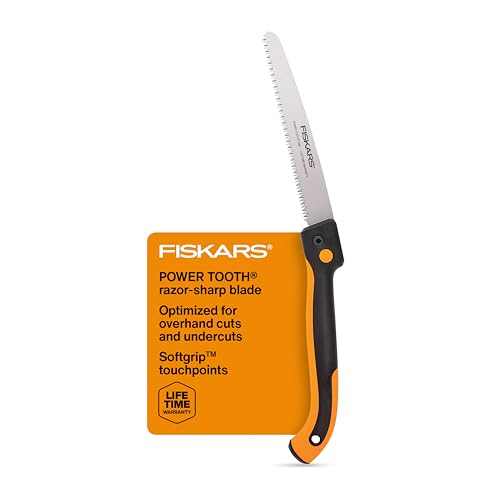
Fiskars Power Tooth Folding Saw 10-Inch
Fiskars Power Tooth Folding Saw 10-Inch
Best for: Homeowners who prune shrubs and small trees regularly and want a sturdy folder with a strong warranty behind it.
10-inch triple-ground Power Tooth blade
Dual-position locking blade for overhand and under cuts
Homeowners who prune shrubs and small trees regularly and want a sturdy folder with a strong warranty behind it.
Watch out for
The listing states no maximum branch diameter and no blade steel grade, so buyers cutting very thick hardwood should compare that detail against the Corona or Silky before deciding.
The Fiskars Power Tooth folding saw earns its place as the dependable all-rounder, pairing a 10 inch triple-ground blade with a dual-position lock that lets the blade sit at two angles for overhand cuts and undercuts. That second locking position helps when a branch grows at an awkward angle above your head, and the soft-grip handle keeps control steady through long pruning sessions without the hand fatigue a bare plastic handle causes.
Watch out for: The listing states no maximum branch diameter and no blade steel grade, so buyers cutting very thick hardwood should compare that detail against the Corona or Silky before deciding.
Bahco Laplander Folding Saw
Bahco Laplander Folding Saw
Best for: Hikers, campers, and trail workers who need a capable saw that adds almost no weight to a pack.
7.5-inch blade with XT toothing, 7 TPI
Swedish steel blade with rust-resistant low-friction coating
The Bahco Laplander is the lightest saw here and the one most often found in hiking packs, because its 7.5 inch Swedish steel blade folds into a compact handle that weighs barely more than a phone. Its XT toothing cuts green wood, dry wood, and even bone and plastic, while the rust-resistant low-friction coating keeps the blade sliding freely in sappy cuts, and the safety lock secures the blade both open and closed.
Watch out for: The shorter blade runs out of reach on limbs much past wrist thickness, so it is a poor pick as your only saw for a mature orchard.
Which One Fits Your Situation
A suburban garden with shrubs and one or two trees
Pick the Corona RazorTOOTH 10 inch. Its curved 10 inch blade covers everything from rose canes to wrist-thick limbs, it folds safely into a tool bucket between jobs, and it costs far less than a professional saw while cutting fast enough that pruning stops feeling like a chore. The lock-back mechanism keeps the blade secure in use and in storage, so it is safe to carry in a pocket or belt all day.
A mature orchard or regular tree work
Pick the Silky Zubat Ultimate 330. The 13 inch curved blade and progressive teeth move through thick limbs with fewer strokes, the scabbard keeps it safe on a belt, and the hardened steel holds an edge through a full day of cutting that would dull a budget folder by lunch.
A first saw for general home use
Pick the Fiskars Power Tooth 10 inch. The dual-position lock handles awkward overhead cuts, the soft grip stays comfortable during a long session, and the lifetime warranty gives a first-time buyer confidence that a single purchase will last through many seasons of garden work. The 10 inch blade covers most shrub and small-tree work, and the folding design means it stores safely in a drawer or tool bag between seasons.
A saw that lives in a backpack
Pick the Bahco Laplander. At just over 7 ounces it disappears into a pack, the lock keeps it shut during a hike, and the XT teeth still cut trail limbs and campsite wood cleanly when you need to clear a path or prep firewood. The rust-resistant coating holds up in wet weather, and the leather strap keeps the saw attached to your wrist while you work on uneven ground.
Common Mistakes
Buying a 7 inch saw for a yard full of 5 inch limbs, then forcing the blade and bending it.
Cutting with a dull blade and tearing the bark, which leaves a ragged wound that heals slowly.
Folding a saw shut while the blade is still wet, which invites rust on the teeth and the hinge.
Sawing a branch from underneath without supporting it, so the limb splits and tears the trunk.
Skipping the scabbard or lock check and carrying an exposed fixed blade loose in a tool bag.
Frequently Asked Questions
What size hand pruning saw do I need for most garden work?
A 10 inch blade suits most home gardens, since it cuts branches up to about 6 inches across, which covers shrubs, small trees, and storm-damaged limbs. Smaller 7 inch blades are better for light shrub work and trail carry, while 13 inch blades belong in orchards where limbs regularly exceed wrist thickness.
Should I choose a folding or a fixed-blade pruning saw?
Choose folding when the saw travels with you, because the blade closes into the handle and needs no separate sheath in a pocket or pack. Choose fixed when the saw stays in a shed or on a belt for heavy orchard days, since fixed blades run longer and give a sturdier grip for repeated thick cuts.
Can a hand pruning saw cut through a 6 inch branch?
Yes, a 10 inch curved blade with aggressive teeth can cut a 6 inch branch, though it takes steady strokes and a few minutes of work. Cut from one side until the kerf deepens, then finish from the other side if the blade binds, and support the branch so it does not split and tear the trunk as it falls.
How do I keep a pruning saw sharp?
Wipe the blade clean and dry after each use, keep it lightly oiled during storage, and store it locked shut or in its scabbard. Impulse-hardened and triple-ground teeth are not meant for ordinary files, so replace the blade when it stops biting cleanly instead of grinding the teeth down.
9
99klik Editorial Team
We compare specs, materials and verified owner reviews before a product earns a spot. Rankings are never paid.
Affiliate disclosure. As an Amazon Associate we earn from qualifying purchases at no extra cost to you. Prices accurate as of the date shown.
Compare five X99 motherboards for LGA 2011-3 gaming builds, from compact Micro-ATX boards to dual-CPU E-ATX models, and pick the right fit for your build.
Compare four infrared gas grills from Amazon listings, from a four-burner Amplifire cabinet to a portable TRU-Infrared grill, with burner and size specs.
Compare five bowhunting arrows by spine, grains per inch and straightness: Easton 6.5 Bowhunter, Gold Tip Hunter XT, Easton FMJ and two Victory builds.
Four 1x prism sights with etched reticles compared on eye relief, reticle design, brightness settings and weight, plus a clear pick for each rifle setup.
Find grass seed that grows in Ohio shade, from dense-shade mixes that need only a few hours of sun to fast-establishing blends for patchy lawns under trees.
Compare bypass pruning shears from Felco, ARS, Fiskars and gonicc by cut capacity, blade steel and grip fit, with picks for large hands and weaker grips.


 Bahco Laplander Folding Saw