We independently review everything we recommend. When you buy through our links, we may earn a commission. As an Amazon Associate we earn from qualifying purchases.
How Many Volts Is a Lithium Ion Battery? A Clear Answer
How many volts is a lithium ion battery? A single cell is 3.7 volts nominal. See how cell voltage works and the best 3.7V 18650 rechargeable picks.
How many volts is a lithium ion battery? A single lithium-ion cell has a nominal voltage of 3.7 volts. That is the figure printed on the cell and the figure device makers design around. The same cell measures about 4.2 volts when fully charged and falls toward 3.0 volts or lower as it discharges, with a typical cut-off near 2.75 volts. Packs reach higher voltages by wiring cells in series: two cells give 7.4 volts, three give 11.1 volts, and so on. This guide explains cell voltage in plain terms, covers the common 18650 size, and shows how to read a listing without being misled by inflated capacity claims. The picks below are five 3.7 volt 18650 rechargeable lithium-ion batteries, all verified as currently listed on Amazon US. The answer in this article is general knowledge about battery chemistry, not the result of any practical measurement by this site.
At a Glance
One lithium-ion cell measures 3.7 volts nominal, about 4.2 volts fully charged, and near 3.0 volts when discharged.
Some lithium-ion chemistries use 3.6 volts nominal instead of 3.7 volts; the difference is small and both charge to 4.2 volts.
Packs add voltage by wiring cells in series: 2 cells in series give 7.4 volts, 3 cells give 11.1 volts.
The 18650 is the most common cylindrical lithium-ion size: 18 mm across and 65 mm long.
Real single 18650 cells hold roughly 2,000 to 3,500 milliamp-hours; claims far above that range deserve a second look.
Flat top and button top cells are not interchangeable in every device, and protected cells are longer than unprotected ones.
How to Choose
The voltage answer in detail
The figure 3.7 volts is a nominal voltage, which means it is the average voltage across a full discharge, not a fixed output. A freshly charged lithium-ion cell reads about 4.2 volts. As the device draws power, the voltage falls gradually, spending most of the discharge near 3.7 volts, then dropping more steeply below 3.3 volts. Most devices cut off near 3.0 volts, and the protection circuits in the picks below cut off near 2.75 volts. Discharging below that point can damage the cell, which is why a proper charger and a protection circuit matter. Lithium iron phosphate cells are the common exception: they run at 3.2 volts nominal and charge to 3.65 volts, so a listing that says 3.2 volts is describing a different chemistry, not a weaker lithium-ion cell.
Series, parallel, and what the label means
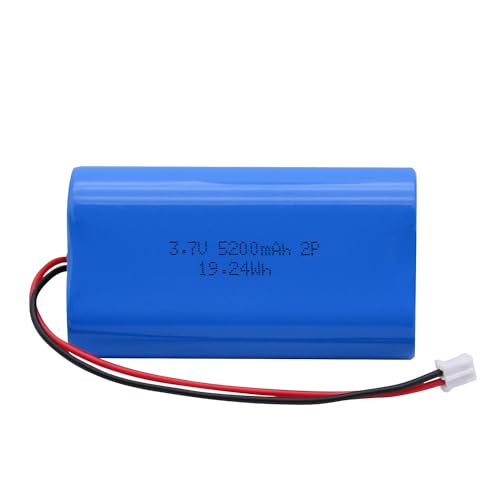
Battery packs combine cells in two ways, and the label tells the story. Cells in series add voltage: a 2S pack holds two cells in series and reads 7.4 volts, while a 3S pack reads 11.1 volts. Cells in parallel add capacity: a 1S2P pack holds two cells side by side, still reads 3.7 volts, but holds twice the milliamp-hours of one cell. The YTKavq pick below is a 1S2P pack, which is why its listing states 5,200 milliamp-hours at 3.7 volts; that figure describes the pair, not a single cell. Reading the series and parallel markings on a pack avoids the most common confusion in lithium-ion listings.
The 18650 size and its variants
The number 18650 describes the cell’s dimensions: 18 mm in diameter and 65 mm long. It is the size used in many flashlights, headlamps, vapes, power tools, and DIY electronics. Within that size there are important variants. Flat top cells have a flat positive end and suit devices with spring contacts or battery holders. Button top cells have a small raised nub and suit devices built for that shape, including many flashlights with a physical reverse-polarity guard. Protected cells carry a small circuit board that guards against overcharge, over-discharge, and short circuits; the board adds a few millimeters of length, so a protected cell may not fit a device built for an unprotected cell. High-drain cells suit power tools and bright flashlights, while high-capacity cells suit devices that draw a modest current for a long time.
Spotting inflated capacity claims
A genuine single 18650 cell holds roughly 2,000 to 3,500 milliamp-hours, depending on its design. Listings that claim 9,900 milliamp-hours for one 18650 cell are not describing a real single cell. The honest explanations for a large number are a multi-cell parallel pack, a different and larger cell size, or a made-up figure. In this roundup, the YTKavq listing states 5,200 milliamp-hours, and its own detail table states 2,600 milliamp-hours per cell with a 19.24 watt-hour total, which matches a two-cell parallel pack; the article states that plainly rather than repeating the headline figure on its own. The Samsung pick below carries its own warning: its bullets describe a 2,500 milliamp-hour cell while its detail table lists 3,000 milliamp-hours, so the article states both figures and does not pick one as settled.
Safety basics that matter more than brand
Lithium-ion cells store a large amount of energy in a small can, so handling matters. Use a charger made for lithium-ion cells and never charge a cell that is dented, swollen, or hot. Do not mix old and new cells in one device, and do not mix cells of different brands or capacities in the same pack. Keep loose cells in a case so the terminals cannot touch keys or coins in a pocket or bag. Store cells at room temperature and away from heat, and recycle worn cells at a battery collection point rather than putting them in household waste. A cell that has been dropped hard or exposed to water should be retired. These are general safety practices for lithium-ion cells, stated here as guidance rather than as a claim about any single product.
How the picks below were chosen
All five picks are 3.7 volt 18650 rechargeable lithium-ion batteries with published voltage, capacity, and form figures taken from their Amazon listings. Each one was checked twice on the Amazon product page through a translated view, and each showed a live buy box with a Buy Now button. The EBL 18650 two-pack was checked and excluded: its product page returned a not-found response on two separate checks while a known live control listing loaded normally in the same session, so it is treated as delisted rather than live. Three of the five picks have thin listings with few published details, and those are flagged in their sections. Capacity figures in this article are the listing’s own figures, and where a listing contradicts itself, the article states the conflict instead of smoothing it over.
The Picks
1. Samsung 25R 18650 3.7V Flat Top Rechargeable Battery, 4-Pack
Top Pick
1. Samsung 25R 18650 3.7V Flat Top Rechargeable Battery, 4-Pack
The Samsung 25R is one of the best-known 18650 cells, a high-drain cell used in flashlights, power tools, and other devices that draw a strong current. This listing sells four flat top cells under the seller brand SOOCOOL, and its title describes them as authentic Samsung 25R cells. Two cautions belong in the open. First, the listing contradicts itself on capacity: its bullets describe a 2,500 milliamp-hour cell, which matches the genuine Samsung 25R, while its detail table lists 3,000 milliamp-hours. This article states both figures and does not settle the question; the 2,500 figure is the one that matches the known cell. Second, the brand field on the listing reads SOOCOOL rather than Samsung, so the authenticity wording is the listing’s own claim, not a fact this site can confirm. Check the cell markings on arrival and confirm the flat top shape suits the device, because a flat top cell will not make contact in a holder built for a button top.
The IMREN four-pack is the high-capacity pick in this roundup, with its title stating 3.7 volts and 3,500 milliamp-hours per cell. IMREN is an established name in rechargeable cells for flashlights and vapes, and a 3,500 milliamp-hour figure sits at the top of the realistic range for a single 18650. The listing itself is thin: it publishes no bullets beyond the title, no dimensions, and no discharge current, and its brand field reads BWIETE rather than IMREN. The listed weight is 8 ounces for the pack, and the listing carries a 12-month warranty. Because the listing publishes so little, treat this pick as the one that needs the most confirmation on arrival: check the cell markings, confirm the flat top or button top shape, and confirm the length fits the device before relying on it. Its place in this roundup rests on the live buy box and the title figures, not on a detailed listing.
3. Yuntunele 18650 3.7V 3500mAh Flat Top Rechargeable Battery, 2-Pack
The Yuntunele two-pack states 3.7 volts, 3,500 milliamp-hours, and 12.95 watt-hours per cell, which is internally consistent: 3.7 volts multiplied by 3.5 amp-hours gives 12.95 watt-hours. The cells are flat top, which suits flashlights, headlamps, digital cameras, toys, and doorbells with spring contacts, according to the listing. The listing is thin, publishing no dimensions, no discharge current, and no protection-circuit detail, so confirm the length and the top shape against the device before ordering. A 3,500 milliamp-hour figure sits at the top of the realistic range for one 18650 cell, so buyers who need a proven high-drain cell rather than maximum capacity should weigh the Samsung pick instead. For general use in flashlights and headlamps, this two-pack covers a device and a spare.
The XINLANTECH pick is the most fully specified listing in this roundup, and it is built for a different job from the bare cells above: it is a single 18650 cell wired to a JST XH2.54 two-pin connector, made as a drop-in replacement pack for small electronics. Its listing states 3.7 volts nominal, a 4.2 volt charge limit, a 2.75 volt cut-off, 2,600 milliamp-hours, and 9.62 watt-hours, with a built-in battery management circuit that guards against overcharging and short circuits. Approximate size is 2.68 by 1.46 by 0.75 inches including the connector, and the listed weight is 49 grams. The listing warns to check polarity before use, with the red wire as positive and the black wire as negative. This is the pick for replacing a wired 18650 pack in a device such as a toy, a small camera accessory, or a DIY project; it is not a bare cell for a flashlight, and the connector must match the device’s socket.
The YTKavq pick is a two-cell parallel pack, and that fact explains its headline figure. Its listing states 3.7 volts and 5,200 milliamp-hours, with a 19.24 watt-hour total, a PH2.0 two-pin connector, and dimensions of 66 by 37 by 20 mm at 98 grams. The detail table states 2,600 milliamp-hours per cell and 9.62 watt-hours per cell, which confirms the construction: two 2,600 milliamp-hour cells wired in parallel, giving 5,200 milliamp-hours combined at 3.7 volts. This is a legitimate pack design, not a single cell with an inflated figure, and the article states it that way. The pack suits flashlights, drones, remote controls, and RC toys that take a wired PH2.0 pack. Confirm the connector type and the 66 mm length against the device’s battery bay, because a two-cell pack is wider and heavier than a single 18650 and will not fit a holder built for one cell.
Comparison Table
Battery
Voltage
Capacity
Form
Connector
Weight
Samsung 25R, 4-pack
3.7V
2,500 mAh per listing bullets; 3,000 mAh per detail table
18650 flat top
None, bare cell
Not published
IMREN, 4-pack
3.7V
3,500 mAh per title
18650
None, bare cell
8 oz per pack
Yuntunele, 2-pack
3.7V
3,500 mAh; 12.95 Wh
18650 flat top
None, bare cell
Not published
XINLANTECH
3.7V
2,600 mAh; 9.62 Wh
18650 pack
JST XH2.54/2P
49 g
YTKavq
3.7V
5,200 mAh combined, 2 cells in parallel; 19.24 Wh
1S2P pack
PH2.0/2P
98 g
Which One Fits Your Situation
Flashlight or power tool needing a high-drain bare cell: the Samsung 25R four-pack is the known cell here, with the capacity conflict stated in its section; confirm flat top fit first.
Maximum capacity in a bare cell: the IMREN four-pack states 3,500 milliamp-hours per cell, but its listing is thin, so confirm markings and fit on arrival.
Flashlight or headlamp plus a spare: the Yuntunele two-pack states 3,500 milliamp-hours with internally consistent watt-hours, in flat top form.
Replacing a wired pack in small electronics: the XINLANTECH single cell with a JST XH2.54 connector and built-in management circuit is the only wired pick with a stated cut-off voltage.
Device that takes a wired two-cell pack: the YTKavq 1S2P pack gives 5,200 milliamp-hours combined through a PH2.0 connector; confirm the 66 mm length and the connector before ordering.
FAQ
How many volts is a lithium ion battery?
A single lithium-ion cell is 3.7 volts nominal. It measures about 4.2 volts when fully charged and falls toward 3.0 volts as it discharges. Packs reach higher voltages by wiring cells in series.
Is every lithium-ion battery 3.7 volts?
No. Most lithium-ion cells are 3.7 volts nominal, or 3.6 volts for some chemistries, but lithium iron phosphate cells run at 3.2 volts nominal. Always read the voltage printed on the cell or the pack rather than assuming.
What does 18650 mean?
The number 18650 describes the cell size: 18 mm in diameter and 65 mm long. It says nothing about voltage or capacity on its own; a separate listing figure gives those.
Can I use a 3.7 volt battery in a device made for 1.5 volt AA batteries?
No. A 3.7 volt lithium-ion cell delivers far more voltage than a 1.5 volt alkaline AA cell, and using it in a device built for AA cells can damage the device. Some AA-size lithium cells include a built-in circuit that drops the output to 1.5 volts; only those are safe in AA devices, and the listing must state that behavior.
How do I know if a capacity claim is realistic?
A genuine single 18650 cell holds roughly 2,000 to 3,500 milliamp-hours. A claim far above that range for one cell deserves a second look. Check whether the listing describes a multi-cell pack, and compare the watt-hour figure: watt-hours should equal volts multiplied by amp-hours.
Do lithium-ion batteries need a special charger?
Yes. Lithium-ion cells need a charger made for their chemistry, with a 4.2 volt charge limit for standard cells. A charger made for nickel-based cells or for lead-acid batteries will not charge them correctly and can damage them.
Final Take
A lithium-ion battery is 3.7 volts per cell, 4.2 volts fully charged, and near 3.0 volts when discharged, with packs reaching higher voltages by wiring cells in series. The 18650 size covers most everyday uses, from flashlights to DIY electronics, and the honest way to read a listing is to check the voltage, the capacity, the top shape, and the connector, then compare the watt-hour figure against the other numbers. In this roundup, the Samsung 25R is the known high-drain cell with a capacity conflict stated openly, the IMREN and Yuntunele packs state 3,500 milliamp-hours with thin listings, the XINLANTECH is the best-documented wired replacement, and the YTKavq is a genuine two-cell parallel pack whose 5,200 milliamp-hour figure describes the pair. Match the form and the connector first, and confirm any thin listing on arrival.
9
99klik Editorial Team
We compare specs, materials and verified owner reviews before a product earns a spot. Rankings are never paid.
Affiliate disclosure. As an Amazon Associate we earn from qualifying purchases at no extra cost to you. Prices accurate as of the date shown.
Galaxy Z Flip vs Galaxy S20 Ultra compared on display, cameras, battery and size, with five Amazon Renewed picks to help you choose the right 2020 Samsung.
Best Japanese vegetable cleaver guide: five nakiri knives compared on steel, edge angle, handle and weight, so you can pick the right one for produce prep.
What is a UPS battery? It is the sealed lead-acid battery inside a UPS that keeps devices running during an outage. See how it works and the best 12V 9Ah picks.
Does RV battery work directly offf batery or throungh nverter? DC loads run off the battery; AC loads need an inverter. See five 12V 100Ah RV batteries.
Can one replace the battery in a t900 tablet? Yes — the Galaxy Tab Pro 12.2 SM-T900 uses a 9500mAh cell. See five replacement kits and what the swap involves.
The best metals for earth battery builds are copper, magnesium, and aluminum-zinc. Compare voltage pairs and forms, and how long each metal lasts in soil.
Best THC batteries nectar collector picks: three 510-thread batteries with adjustable voltage, USB-C charging, and LED displays for standard attachments.

 1. Samsung 25R 18650 3.7V Flat Top Rechargeable Battery, 4-Pack
 2. IMREN 18650 3.7V Rechargeable Battery, 4-Pack