We independently review everything we recommend. When you buy through our links, we may earn a commission. As an Amazon Associate we earn from qualifying purchases.
Best Japanese Vegetable Cleaver
Best Japanese vegetable cleaver guide: five nakiri knives compared on steel, edge angle, handle and weight, so you can pick the right one for produce prep.
Best Japanese vegetable cleaver guide: five nakiri knives compared on steel, edge angle, handle and weight, so you can pick the right one for produce prep.
Disclosure: As an Amazon Associate, this site may earn from qualifying purchases made through links on this page.
A Japanese vegetable cleaver, better known as a nakiri, is the one knife in a Japanese kitchen built for a single job: cutting vegetables. The blade is tall, rectangular and dead flat along the edge, with a squared-off tip and no point at all. When you push it straight down through an onion, a carrot or a head of cabbage, the whole edge meets the board at once, so every slice separates cleanly. That flat edge is the whole idea. A chef’s knife rocks; a nakiri does not. It chops straight down or pushes forward, and it does that one motion better than any curved blade.
The best Japanese vegetable cleaver for most home cooks is a double-bevel nakiri with a blade between 6.5 and 7 inches long, thin behind the edge, and light enough to use for a full pile of produce without tiring your hand. Japanese steel in this shape is usually hard, often around HRC 60, which takes a keen edge and holds it for months, but it can chip if you twist it through a squash or hit a bone. Softer steel dulls sooner and comes back on a stone in minutes. Both have a place, and the right pick depends on how you cook and how you sharpen.
This guide compares five nakiri knives that are sold on Amazon US: the Tojiro DP, the Global G-5, the Shun Classic, the MAC Professional and the Mercer Culinary Genesis. Four of the five are made in Japan. The Mercer is a Japanese-style nakiri made in Taiwan from German steel, and it is included because it is the most forgiving way to find out whether you like the shape. Every pick below is a nakiri vegetable knife, and nothing else. No chef’s knife, no santoku and no Chinese bone cleaver appears in the picks. A nakiri is not a bone cleaver: the blade is far too thin for bones or frozen food, and using it that way is exactly how a hard Japanese edge chips.
At a Glance
Best overall: Tojiro DP 6.5-Inch Nakiri (F-502) — thin VG-10-class core, Western handle, the sharpest all-rounder here.
Most nimble: Global G-5 7-Inch Vegetable Knife — one-piece stainless, featherweight, easy to clean.
Best planted feel: MAC Professional 6.5-Inch Nakiri (MJU-65) — heavier Japanese blade with a bolstered Pakkawood handle.
Best forgiving pick: Mercer Culinary Genesis 7-Inch Nakiri (M20907) — forged, full tang, grippy handle, the toughest steel here.
If you chop a lot of vegetables and want real Japanese sharpness, start with the Tojiro. If you want the most nimble knife in the group, pick the Global. If you want a beautiful knife with a factory sharpening service, pick the Shun. If you want a sturdier Japanese blade, pick the MAC. If you are trying the shape for the first time, pick the Mercer.
How to Choose
Blade length and height. Nakiri blades run 6.5 to 7 inches long, and the height of the blade matters as much as the length. A tall blade gives your knuckles clearance over the board and doubles as a scoop for moving diced onion to the pan. All five picks here sit in that range, so length is not the deciding factor.
Thinness behind the edge. This is the one spec that decides how a nakiri cuts. A thin blade drops through dense vegetables. A thick blade wedges: the carrot cracks or the potato splits ahead of the edge instead of parting cleanly. The Tojiro and the MAC are ground thin. The Mercer is noticeably thicker behind the edge, which is why it wedges more in dense roots.
Steel and hardness. Hard Japanese steel, such as the VG-10-class core in the Tojiro and the VG-MAX core in the Shun, takes a keener edge and holds it longer, but it is thinner and more chip-prone. Softer steel, such as the forged German stainless in the Mercer, dulls sooner but comes back on a stone in minutes and resists chipping. The Global uses Cromova 18 stainless, a molybdenum and vanadium stainless that sits between the two in character.
Edge angle. The Shun is ground to 16 degrees per side. The Tojiro is listed at 9 to 12 degrees. The Mercer is taper-ground with a smooth edge and no published angle. A lower number is not automatically better: a keen angle on soft steel and a wider angle on hard steel can end up equally sharp and equally durable.
Handle. The Tojiro and the MAC use laminated wood and Pakkawood handles with a bolster, in a Western style that feels familiar to anyone coming from a German chef’s knife. The Shun uses a D-shaped Pakkawood handle that locks into your grip and works for either hand, though it runs slim for large hands. The Global is one piece of stainless with a dimpled grip: seamless, easy to clean, and slippery when your hands are wet or oily. The Mercer uses a soft Santoprene handle that stays grippy when wet.
Care. Every pick here should be washed by hand and dried right after washing. Hard Japanese steel can rust if left wet, and even stainless blades can develop small rust spots when they sit damp. No nakiri in this guide belongs in a dishwasher, and none of them should cut bones, frozen food or joints.
Made in Japan, or Japanese style. Four picks are made in Japan: the Tojiro, the Global, the Shun and the MAC. The Mercer is made in Taiwan from German steel in a Japanese shape. It is a nakiri by design and by use, and it is the only pick here with NSF certification for commercial kitchen use, but it is not a Japanese-made knife.
The Picks
1. Tojiro DP 6.5-Inch Nakiri (F-502)
The Tojiro DP is the nakiri to buy if you want one knife that does the vegetable job properly: thin, hard and seriously sharp, with a Western handle that feels familiar from the first cut. The blade measures 6.5 inches, or 165 mm, with a plain edge. The core is a VG-10-class cobalt alloy, clad in three layers of stainless, hardened to HRC 60 per the listing, with an edge angle of 9 to 12 degrees per the listing. The knife weighs about 6.7 ounces, and the handle is laminated wood in a bolstered Western style. It is made in Japan, and the care instruction is hand wash only.
The appeal is the steel. A hard VG-10-class core clad in softer stainless, ground thin, drops through onions, carrots and cabbage with almost no wedging, and the edge holds for months of home use between sharpenings. The Western handle and small bolster make it easy for anyone coming from a German chef’s knife. The trade-offs are the usual ones for hard Japanese steel: it can chip if you twist it in a squash or hit a bone, and it should never sit wet. Availability on Amazon sometimes runs through third-party sellers, so check that the seller is reputable before you buy.
The Global G-5 is a sleek, featherweight nakiri that zips through herbs and soft produce. The blade measures 7 inches with a plain edge. The steel is Cromova 18 stainless, a molybdenum and vanadium stainless. The knife weighs about 6.8 ounces. The handle is one piece of stainless with a dimpled grip, and there are no seams for food to collect in. It is made in Japan, and the listing carries a lifetime warranty. The care instruction is hand wash only.
The G-5 is light and nimble, and the stamped one-piece design means the whole knife cleans in seconds. The dimpled steel handle is easy to grip when dry and stays clean, though some cooks find it slippery with wet or oily hands. The light blade has less momentum on dense roots than the heavier picks here, so it suits herbs, leafy greens, onions and soft produce more than a pile of raw sweet potatoes. A handful of owners report small rust spots, almost always after the knife was left wet, so dry it right after washing.
The Shun Classic is the good-looking, very sharp nakiri that also makes a great gift. The blade measures 6.5 inches with a plain edge, ground to 16 degrees per side. The core is VG-MAX steel with 68 layers of Damascus cladding. The handle is D-shaped Pakkawood. It is made in Japan, and Shun provides a factory sharpening and honing service for the knife. The care instruction is hand wash only.
The VG-MAX core takes a very keen 16-degree edge, and the Damascus cladding is as much about looks as performance. The D-shaped Pakkawood handle locks into your grip and works for either hand. You pay for the finish: it sits above the Tojiro, which cuts just as well, and the handle runs slim for large hands. Like other hard Japanese blades it can chip if you twist through frozen food or bone. The factory sharpening service takes the hardest maintenance job off your hands over time.
The MAC Professional is a sturdier Japanese nakiri for cooks who already love MAC knives. The blade measures 6.5 inches with a plain edge. The steel is a molybdenum alloy steel, and the handle is Pakkawood with a bolster. It is made in Japan, and the care instruction is hand wash only.
The Professional line is the same series as the MAC santoku and chef’s knife, and this nakiri brings the same thin, keen MAC grind to a flat vegetable blade. It feels more substantial than the Global, which some cooks prefer for dense roots and cabbage, and the bolstered handle gives a planted, confident grip. Be aware that the US Amazon listing has only a couple dozen owner comments, so there is less long-term owner feedback than for the Shun or the Global, and MAC publishes no hardness or weight figure for this model, so those cells stay blank rather than guessed.
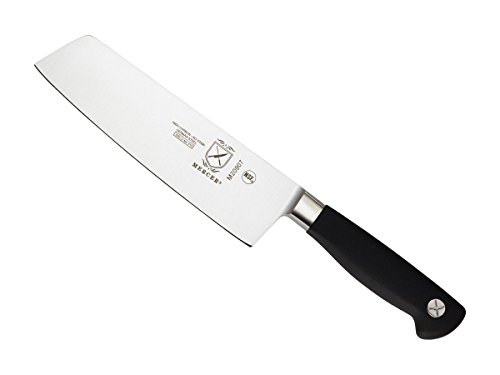
The Mercer Culinary Genesis is a sturdy, forgiving nakiri that lets you try the shape without a big outlay. The blade measures 7 inches with a plain edge. The steel is forged high-carbon German stainless, and the knife is forged and full tang, with a non-slip Santoprene handle. It is NSF certified for commercial kitchen use, and it is made in Taiwan. The care instruction is hand wash recommended.
Mercer’s Genesis line is a culinary-school staple, and the M20907 brings the same forged German steel and soft-grip Santoprene handle to the nakiri shape. The blade is thicker and softer than the Japanese picks, so it will not feel as razor-like on a ripe tomato, but it is far more forgiving of a hard squash or a careless drop into the sink. The grippy handle stays secure when wet, and the softer steel comes back to sharp in a couple of minutes on a stone. The trade-offs are a thicker blade that wedges more in dense vegetables and more frequent honing than Japanese steel needs.
Where a maker does not publish a figure, the table says so rather than guessing. The Tojiro and the Global are the only picks with a published weight, and the Tojiro and the Shun are the only picks with a published edge angle.
Which One Fits Your Situation
You chop vegetables every day and want the sharpest all-rounder. Pick the Tojiro DP. The thin VG-10-class core and the 9 to 12 degree edge make it the keenest cutter here, and the Western handle needs no adjustment period.
You want the most nimble knife and the easiest cleaning. Pick the Global G-5. At about 6.8 ounces with a seamless one-piece stainless body, it is the simplest to wash and dry, as long as your hands are dry when you grip it.
You want a beautiful knife with factory sharpening. Pick the Shun Classic. The Damascus cladding and the D-shaped Pakkawood handle make it the showpiece of the group, and the factory sharpening service takes the hardest maintenance job off your hands.
You already own MAC knives or want a heavier Japanese blade. Pick the MAC Professional MJU-65. It matches the MAC santoku and chef’s knife, and the bolstered handle and planted feel suit cooks who like a little weight behind the edge.
You are trying a nakiri for the first time or cook in a busy household. Pick the Mercer Genesis. The forged full-tang build, the grippy Santoprene handle and the forgiving German steel mean it survives the knocks that would chip a harder Japanese blade, and it is the easiest pick here to bring back to sharp on a stone.
You cut a lot of dense roots and squash. Lean toward the Tojiro or the MAC. Their thin grinds part dense vegetables instead of wedging, while the Mercer and the Global work harder on the same job.
FAQ
What is a Japanese vegetable cleaver?
It is a nakiri: a Japanese vegetable knife with a straight, flat edge and a squared-off tip. It is made for push-cutting and chopping straight down through vegetables, so every part of the edge meets the board at once. It is not meant for bones, frozen food or meat with joints.
Is a nakiri the same as a Chinese vegetable cleaver?
No. A nakiri looks like a small cleaver, but the blade is much thinner and is never used for chopping through bone. A Chinese vegetable cleaver is a heavier, more versatile blade. A nakiri is a specialist: vegetables only, and it does that job better than a general cleaver.
Nakiri vs santoku: which should I buy?
A santoku has a slight curve and a usable tip, so it handles vegetables plus boneless meat and fish. A nakiri is completely flat and has no point, which makes it better at pure vegetable chopping but less versatile. If you want one all-rounder, get a santoku or a chef’s knife.
Nakiri vs usuba: what is the difference?
An usuba is the professional single-bevel cousin of the nakiri, used for paper-thin decorative cuts. It is handed, left or right, and it needs whetstone sharpening, so most home cooks are better served by a double-bevel nakiri. Every pick in this guide is double-bevel.
Can a nakiri cut meat?
It can cut boneless meat and fish in a pinch, because the edge is sharp and the blade is tall, but that is not its job. The flat edge has no tip for trimming, and the thin hard steel can chip on a joint or a bone.
How do I keep a nakiri sharp?
Hone it lightly before use and sharpen it on a whetstone a few times a year. Wash it by hand, dry it right after washing, and store it where the edge never knocks against other steel.
Do I need a nakiri if I already own a chef’s knife?
Not necessarily. A chef’s knife does most kitchen jobs, and a nakiri is a second knife, not a first one. Buy it because you prep a lot of vegetables and want that work to go faster and come out more even, not because you expect it to replace anything.
Final Take
The best Japanese vegetable cleaver is the one that matches how you cook and how you sharpen. The Tojiro DP is the strongest all-round pick: thin, hard, sharp, and honest about its limits. The Global G-5 is the most nimble and the easiest to clean. The Shun Classic is the most beautiful and the only pick with a factory sharpening service. The MAC Professional is the planted, heavier Japanese option for cooks who already trust the brand. The Mercer Genesis is the forgiving entry point for anyone trying the shape for the first time.
Whichever you pick, remember the three rules that keep a nakiri working for years: vegetables only, hand wash and dry right away, and a whetstone instead of a pull-through sharpener.
9
99klik Editorial Team
We compare specs, materials and verified owner reviews before a product earns a spot. Rankings are never paid.
Affiliate disclosure. As an Amazon Associate we earn from qualifying purchases at no extra cost to you. Prices accurate as of the date shown.
Galaxy Z Flip vs Galaxy S20 Ultra compared on display, cameras, battery and size, with five Amazon Renewed picks to help you choose the right 2020 Samsung.
What is a UPS battery? It is the sealed lead-acid battery inside a UPS that keeps devices running during an outage. See how it works and the best 12V 9Ah picks.
Does RV battery work directly offf batery or throungh nverter? DC loads run off the battery; AC loads need an inverter. See five 12V 100Ah RV batteries.
Can one replace the battery in a t900 tablet? Yes — the Galaxy Tab Pro 12.2 SM-T900 uses a 9500mAh cell. See five replacement kits and what the swap involves.
The best metals for earth battery builds are copper, magnesium, and aluminum-zinc. Compare voltage pairs and forms, and how long each metal lasts in soil.
Best THC batteries nectar collector picks: three 510-thread batteries with adjustable voltage, USB-C charging, and LED displays for standard attachments.

 2. Global G-5 7-Inch Vegetable Knife
 3. Shun Classic 6.5-Inch Nakiri (DM0728)
 4. MAC Professional 6.5-Inch Nakiri (MJU-65)
 5. Mercer Culinary Genesis 7-Inch Nakiri (M20907)