
Key takeaways
- Fill between the minimum and maximum lines only; overfilling can cause boiling water to spit from the spout.
- Use the kettle on its own base on a flat, dry surface, and keep the cord away from the edge of the counter.
- Only rely on boil-dry protection or auto shut-off if the maker states it for your model, and follow the manual.
- Keep steam and the spout away from hands, children and pets; the outside of some metal and glass kettles gets hot.
- Descale regularly with the method the maker recommends, as mineral scale reduces performance and can affect taste. Avoid harsh chemicals not named in the manual.
- Do not immerse the base or the kettle’s electrical parts in water.
For most households the Cuisinart PerfecTemp CPK-17P1 is the value pick under $150, the Breville IQ Kettle Pure suits buyers who want five temperature presets and a glass jug, and the Fellow Stagg EKG suits anyone who brews pour-over coffee every day and wants a gooseneck spout. A plain, fixed-temperature kettle is enough if you only boil water for tea bags and instant meals.
Our top picks


As an Amazon Associate we earn from qualifying purchases at no extra cost to you.
At a Glance: Electric Kettles Worth Considering
| Model | Best for | Key points reported | Limits |
|---|---|---|---|
| Cuisinart PerfecTemp CPK-17P1 | Everyday value with temperature presets | Maker lists a 1.7 L capacity, 1500 W, six presets and a limited three-year warranty | Functional rather than stylish, according to reviewers |
| Breville IQ Kettle Pure (BKE830XL) | Temperature presets and a glass jug | Maker lists 1.7 L (57 oz), 1500 W, five presets, a Schott glass jug, a keep-warm button and a removable scale filter | Among the pricier kettles; may sit at the top of the cap |
| Fellow Stagg EKG / EKG Pro | Pour-over coffee | Maker lists 0.9 L capacity, 1200 W and a 135 to 212 degrees F adjustable range on the standard EKG; the Pro adds scheduling and a wider range | Smaller than 1.7 L kettles and lower wattage than 1500 W models; both editions may sit above the cap |
| OXO Brew Adjustable Temperature kettle | Balanced all-round use | OXO lists 1.75 L borosilicate glass, 1500 W, a 30-minute hold and a two-year guarantee; the temperature range differs by version | Mid-range tier |
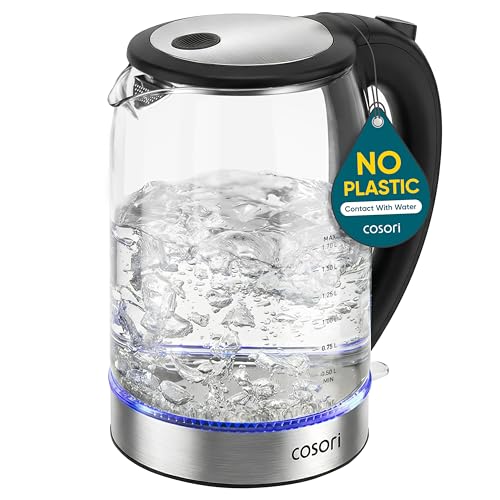
| Cosori glass kettle with presets | Budget variable temperature | Listings describe 1.7 L, 1500 W and six temperature presets | Glass body requires careful handling |
| Ninja Precision Temperature kettle (KT200) | Seven one-touch presets in a stainless body | Maker lists 1.7 L maximum, 1500 W, seven presets plus manual 5 degrees F steps from 105 to 212, a 30-minute hold and a one-year limited warranty | Standard spout, not a gooseneck |
Why an Electric Kettle?
An electric kettle boils water faster than a stovetop kettle in most kitchens, shuts off on its own according to the maker, and heats only the amount you need. Models with variable temperature settings let you match the water to the drink: lower for green tea and delicate brews, near boiling for black tea, herbal infusions and French press coffee.
What to Look For
Capacity
One to 1.7 litres covers most households. The Cuisinart’s 1.7 L suits families that make several cups at once. The Fellow Stagg’s 0.9 L is better for one or two mugs or a pour-over session. Larger kettles are heavier when full, so think about who will lift them.
Wattage and speed
Most mainstream kettles draw about 1500 W. The Fellow Stagg is listed at 1200 W, lower than the 1500 W listed for the Cuisinart, Breville, OXO and Ninja, so it may heat larger volumes more slowly. A slightly slower kettle is rarely an issue for a few cups, but it can matter during a morning rush.
Temperature control
Presets and variable dials add flexibility. The Cuisinart lists six presets; the Fellow lists a 135 to 212 degrees F range; the Breville lists five presets. If you only drink black tea or instant coffee, fixed temperature is enough and saves money.
Materials
Stainless steel is durable and easy to maintain. Glass shows water level and scale but is more fragile. Plastic components touching the water, such as lids or spouts, are a matter of preference. Reviewers sometimes mention a plastic taste in new kettles, which often fades after boiling and discarding a few fills.
Spout and handle
A gooseneck spout, as on the Fellow Stagg, gives control for pour-over coffee. A wide spout fills a teapot or pot quickly. Choose a handle you can grip securely when the kettle is full, and check that the lid opens wide enough for cleaning.
Keep-warm and other extras
Some kettles hold a set temperature for a period, and some have a removable limescale filter. Those are useful but not essential. Look for features the maker states clearly instead of assuming.
Safety and Care
- Fill between the minimum and maximum lines only; overfilling can cause boiling water to spit from the spout.
- Use the kettle on its own base on a flat, dry surface, and keep the cord away from the edge of the counter.
- Only rely on boil-dry protection or auto shut-off if the maker states it for your model, and follow the manual.
- Keep steam and the spout away from hands, children and pets; the outside of some metal and glass kettles gets hot.
- Descale regularly with the method the maker recommends, as mineral scale reduces performance and can affect taste. Avoid harsh chemicals not named in the manual.
- Do not immerse the base or the kettle’s electrical parts in water.
Budget Tiers
Entry level
Fixed-temperature kettles and basic glass models with presets, such as the Cosori, represent the lowest spend. They cover tea bags, instant noodles and oatmeal.
Mid-range
The Cuisinart PerfecTemp and OXO Brew kettles combine presets, larger capacity and strong warranties. For most households, this is the tier to shop in.
Premium
The Breville IQ Kettle Pure and Fellow Stagg offer more preset control or design. Outlets report prices that can reach or pass the cap, particularly for the Fellow Stagg EKG and EKG Pro, so confirm which edition fits your budget.
Pick X If You Want Y
| Pick this | If you want |
|---|---|
| Cuisinart PerfecTemp CPK-17P1 | Six presets, 1.7 L capacity and a warranty at a sensible spend |
| Breville IQ Kettle Pure | Five temperature presets and a glass jug for tea or coffee |
| Fellow Stagg EKG | A gooseneck spout for pour-over coffee |
| OXO Brew Adjustable Temperature | An all-round kettle with simple controls |
| Ninja Precision Temperature (KT200) | Seven one-touch presets and a manual temperature adjustment |
| Cosori glass kettle | Variable temperature at the lowest spend |
Matching Temperature to Drink
Tea and coffee guides commonly suggest around 175 degrees F for green tea, near boiling for black and herbal teas, and about 195 to 205 degrees F for coffee brewing. These are general guidelines, and individual tastes and brands vary. A kettle with variable temperature makes it easy to try different settings. If you do not drink delicate tea or pour-over coffee, you will rarely use anything but boil.
Alternatives to Consider
A stovetop kettle costs less, uses no electricity and suits camping, though it needs a burner and watching. A hot water dispenser or instant-hot tap provides water on demand but costs more and needs installation. A manual gooseneck kettle works on a stove but cannot hold a temperature. If you want a flexible small appliance, consider a multi-cooker that can also heat water, though it is slower for a quick cup.
Fit and Everyday Use
Countertop footprint and cord
Kettles sit on a round or oval power base, so measure the space under cabinets, especially with the lid open. A short cord is a safety feature in many kitchens, but it can limit where the kettle can sit; avoid using an extension lead with a high-wattage appliance, and speak to an electrician if outlets are far from the counter.
Pouring control
A full 1.7 L kettle is heavy, and a broad spout can splash or pour too fast. If you often fill small cups or a French press, a narrower spout or a gooseneck gives steadier flow. Try to find a handle that lets you pour with your wrist straight.
Noise and boil time
Glass and stainless models differ in how loud the boil is, and reviewers report that thicker walls tend to be quieter. Boil time depends on wattage and the volume of water, so a kettle with a lower wattage may take noticeably longer to fill a large teapot.
Offices, dorms and small spaces
A compact kettle of about 1 L is easier to store and quicker to boil for a single mug. If you share a space, check that the product is allowed by the building’s rules and avoid plugging it into overloaded power strips.
Water Quality and Taste
Hard water leaves limescale that coats the heating base and can dull the taste of tea. If your tap water is hard, a filtered jug or a kettle with a removable scale filter helps, and regular descaling keeps boil times consistent. Fresh water for each boil tastes better than reboiling the same water repeatedly, and emptying the kettle after use limits scale buildup between uses.
Frequently Asked Questions
Is a variable-temperature kettle worth it?
It is worth it if you drink green tea, white tea or pour-over coffee often. If you mostly boil water for black tea or instant drinks, a fixed-temperature model is enough.
Glass, stainless steel or plastic?
Stainless steel is the most durable, glass lets you see the water and scale, and plastic is the lightest. Choose based on how you handle the kettle and how often you want to see inside.
How do I remove limescale?
Follow the maker’s descaling instructions, which often involve a mild acidic solution such as diluted white vinegar or a descaler named in the manual. Rinse thoroughly and boil and discard a fill before using the kettle again.
Why does my new kettle taste like plastic?
New kettles can have a faint smell or taste from manufacturing. Boil and discard a few full kettles of water, and the effect usually fades. If it persists, contact the maker.
Does the kettle switch off automatically?
Many do, but only rely on this if the maker states it for your model. Read the manual and never leave a kettle boiling unattended.
What capacity should I choose?
A 1 to 1.2 L kettle suits one or two people, while 1.7 L suits families and entertaining. A smaller kettle is lighter, which can be easier to pour.



