We independently review everything we recommend. When you buy through our links, we may earn a commission. As an Amazon Associate we earn from qualifying purchases.
Best Roland Portable Digital Pianos
Best Roland portable digital pianos: five 88-key Roland pianos for home practice, lessons and gigs, compared for touch, tone, speakers and portability.
Best Roland portable digital pianos: five 88-key Roland pianos for home practice, lessons and gigs, compared for touch, tone, speakers and portability.
Disclosure: As an Amazon Associate, this site may earn from qualifying purchases made through links on this page.
Roland has built its portable piano range around one idea: an 88-key instrument that feels like a piano, sounds like a piano, and still fits in a car. The FP-X series carries that idea across the whole range, from the compact entry-level FP-10 to the stage-ready RD-88 EX. Every pick in this guide has 88 weighted keys, Roland’s PHA-4 Standard action, and the SuperNATURAL piano sound engine, so the differences come down to tones, speakers, weight, and what else the piano does besides play piano.
Portable matters here in two ways. First, the instrument itself: these pianos have no built-in legs, so they sit on a stand you choose, and they move from room to room or venue to venue without a team of movers. Second, the sound: most of them carry built-in speakers, so you can practice without headphones or an amplifier, while the stage model in this guide trades speakers for a lighter body and expects external sound. Read the How to Choose section before the picks if you are unsure how much polyphony, speaker power, or weight matters for your playing, then match yourself to a pick in Which One Fits Your Situation.
At a Glance
Roland FP-30X Black — the all-rounder: 88 weighted keys, 256-note polyphony, Bluetooth audio and MIDI, and built-in speakers.
Roland FP-10 — the entry point: the same PHA-4 action in the most compact and lowest-weight body here.
Roland RD-88 EX — the stage piano: expanded sounds, no built-in speakers, and the most tones in this guide.
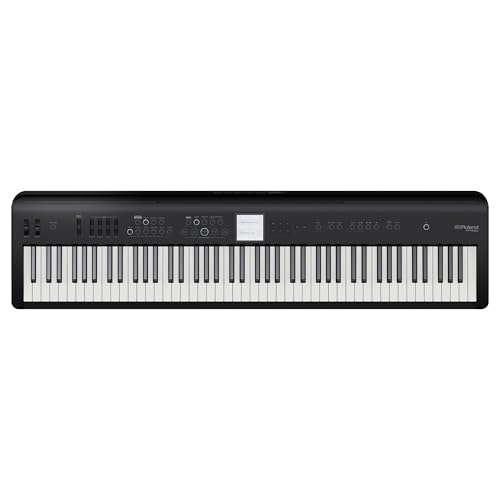
Roland FP-E50 — the accompaniment piano: hundreds of tones plus backing styles that play along with you.
Roland FP-60X Bundle — the midrange FP-X with a stronger amplifier, shipped with a stand, three-pedal unit and bench.
How to Choose
Key action. All five picks use Roland’s PHA-4 Standard action, which gives each key a weighted, hammer-action feel with escapement, the small click you feel near the bottom of a key press on an acoustic piano. That shared action means the touch is consistent across the range; the higher models add sound, speakers and features rather than a different keyboard. If you are moving from an unweighted keyboard, any of these five will feel like a real piano under your fingers.
Sound engine and tones. Roland’s SuperNATURAL engine models the piano tone rather than playing back a single recording per key, so the sound changes with how hard you play. The number of tones tells you how many instruments the piano carries beyond the main piano sound: the FP-10 has 15, the FP-30X has 35, the FP-60X has 350, and the FP-E50 and RD-88 EX carry hundreds to thousands, including electric pianos, organs, strings and synthesizer sounds. More tones matter most to players who gig or compose; for daily practice, the piano tones do the heavy work.
Polyphony. Polyphony is the number of notes the piano can sound at once. The FP-10 gives 96 notes; the other four picks give 256. With the damper pedal down and a lot of notes ringing, a lower polyphony can cut off the oldest notes. For most practice, 96 notes is enough. For dense playing with the pedal held down, 256 notes is the safer number.
Speakers. Built-in speakers decide whether the piano works on its own. The FP-10 has a modest pair, the FP-30X and FP-E50 have a stronger pair, and the FP-60X has the strongest amplifier in the FP-X range. The RD-88 EX has no built-in speakers at all — it is a stage piano, and it expects headphones or an external amplifier. If you plan to practice in a living room without extra gear, pick a model with speakers.
Weight and portability. Weight runs from about 12.3 kg for the FP-10 to about 23.6 kg for the FP-30X and FP-60X, with the RD-88 EX near 13.5 kg and the FP-E50 near 19 kg. If you carry the piano to lessons or gigs, the lighter models save your back. If the piano stays in one room, weight barely matters.
Bluetooth and pedals. Bluetooth audio lets you play music from a phone through the piano’s speakers, and Bluetooth MIDI connects the piano to lesson and notation apps without a cable. Every pick here has Bluetooth in some form. A damper pedal comes with the pianos; a three-pedal unit, which adds soft and sostenuto pedals, is an optional add-on except in the FP-60X bundle in this guide, which includes one.
The FP-30X is the all-rounder of this guide, and it is the pick for most players. It has 88 keys with the PHA-4 Standard action, the SuperNATURAL piano engine, 35 tones, and 256-note polyphony, so it handles everything from beginner pieces to dense pedalled playing without running out of notes. Bluetooth audio and MIDI connect it to a phone or tablet for lesson apps and backing music, and the built-in speakers are strong enough for a living room without an external amplifier.
At about 23.6 kg it is not the lowest-weight piano here, but it is still a one-person carry to a car, and it sits neatly on a portable stand. It is the middle of the FP-X range in every way that matters: more tones and more speaker power than the FP-10, less bulk and less spend than the FP-60X, and a full piano-first design without the accompaniment features of the FP-E50. If you want one piano for home practice, lessons and the occasional move, match this one first.
The FP-10 is the entry point, and it is the pick for beginners and for players who need the lowest-weight piano in this guide. It carries the same PHA-4 Standard action as the rest of the range, so the touch under your fingers is the same piano feel, with 15 tones and 96-note polyphony behind it. Bluetooth MIDI connects it to lesson apps, and the built-in speakers cover quiet practice in a small room.
At about 12.3 kg it is roughly half the weight of the FP-30X, which makes it the easiest pick to carry to lessons or move between rooms. The trade-offs are plain: fewer tones, lower polyphony, and smaller speakers. For a first piano, for a child’s lessons, or for a second piano in a small space, those trade-offs rarely matter, and the action is the part you feel every day.
The RD-88 EX is the stage piano of this guide, and it is the pick for gigging players. It pairs the PHA-4 Standard action with Roland’s expanded sound set: SuperNATURAL piano and electric piano tones plus the ZEN-Core engine, giving more than 3,000 tones in total, with 256-note polyphony. It is built for players who need a wide sound palette on stage and in the studio, and it carries the controls to shape those sounds on the fly.
Two things set it apart from the FP models. First, it has no built-in speakers, so it needs headphones or an external amplifier — normal for a stage piano, and worth knowing before you buy. Second, it is light for what it does, at about 13.5 kg, so it travels well to gigs. If your piano leaves the house for performances, or you compose and need deep sound options, this is the pick to match first.
The FP-E50 is the accompaniment piano of this guide, and it is the pick for players who like backing music behind their playing. It has the same 88-key PHA-4 Standard action as the rest of the range, with more than 500 tones and around 90 accompaniment styles that follow your chords, so you can play a melody over a band-style backing without any other musicians in the room. Bluetooth audio and MIDI are built in, and the built-in speakers cover home practice.
At about 19 kg it sits between the FP-10 and the FP-30X on weight, and its 256-note polyphony handles dense playing with the pedal down. It suits players who enjoy pop, jazz and film-style playing, and it suits teachers who want backing styles for lessons. If you want the piano to play along with you rather than only sounding the notes you press, this is the pick.
The FP-60X bundle is the complete home setup in this guide, and it is the pick for players who want the midrange FP-X piano plus the furniture to go with it. The FP-60X itself sits above the FP-30X in the range, with 350 tones, 256-note polyphony, a stronger built-in amplifier and custom stereo speakers, and the same PHA-4 Standard action. The bundle adds the KSC-72 stand, the KPD-90 three-pedal unit, a bench, an instructional DVD, online lessons and a polishing cloth, so the piano arrives ready to play in a fixed spot at home.
At about 23.6 kg for the piano alone, it is a substantial instrument, and the stand makes it a piece of furniture rather than a portable carry. That is the point of this bundle: it suits a dedicated practice corner where the piano stays put. If you want the strongest FP-X sound in this guide and you do not want to shop for a stand, pedals and a bench separately, match this bundle first.
Most players, home practice and lessons: the FP-30X Black, the all-rounder of this guide.
Beginner, child’s lessons, or a second piano: the FP-10, the lowest-weight and most compact pick here.
Gigging player or composer: the RD-88 EX, with the deepest sound set and a light body for travel.
Player who wants backing styles: the FP-E50, with accompaniment that follows your chords.
Dedicated practice corner with furniture included: the FP-60X bundle, with stand, three-pedal unit and bench.
Quiet practice in a shared home: any pick with built-in speakers plus a pair of standard headphones; the RD-88 EX needs headphones or an external amplifier by design.
FAQ
Do I need a stand for a portable digital piano?
Yes. These pianos have no built-in legs, so they need a stand. A portable X-stand works for lessons and gigs, while a wooden furniture stand suits a fixed spot at home. The FP-60X bundle in this guide includes a stand.
Can I practice with headphones?
Yes. Every pick here has a headphone jack, so you can practice silently. The RD-88 EX has no built-in speakers, so headphones or an external amplifier are part of its normal setup rather than an extra.
What is the difference between 96-note and 256-note polyphony?
Polyphony is how many notes can sound at once. With the damper pedal down, notes keep ringing, and a piano with 96-note polyphony can cut off the oldest notes sooner than one with 256. For most practice, 96 is enough; for dense pedalled playing, 256 is safer.
Do these pianos connect to lesson apps?
Yes. Bluetooth MIDI connects the pianos to lesson and notation apps on a phone or tablet, and Bluetooth audio plays music from the phone through the piano’s speakers on the models that carry it. A USB connection also works for MIDI on a computer.
Is the PHA-4 Standard action the same across the range?
Yes. All five picks use the PHA-4 Standard action, so the weighted, hammer-action touch is consistent from the FP-10 to the FP-60X. The differences between models are tones, speakers, weight and features, not the keyboard itself.
Final Take
Five Roland pianos, one shared action, five different jobs. The FP-30X Black covers most players, the FP-10 covers beginners and light carrying, the RD-88 EX covers the stage, the FP-E50 covers players who want a band behind them, and the FP-60X bundle covers the home setup with furniture included. Pick by how you play and where the piano lives, then check the listing for the included pedal and stand before you buy.
9
99klik Editorial Team
We compare specs, materials and verified owner reviews before a product earns a spot. Rankings are never paid.
Affiliate disclosure. As an Amazon Associate we earn from qualifying purchases at no extra cost to you. Prices accurate as of the date shown.
Compare five 5G capable phones for everyday use, from a simple large-screen handset to a rugged outdoor model, with storage, display, and carrier guidance.
Best ultralight electric scooters for adult urban travel: five folding scooters at or under 31 lb for stairs and trains, compared for weight and brakes.
Find the best action cameras for skiing, from cold-proof flagships to a 360 camera and a value pick. Compare stabilization, battery life, and ski mounts.
The best mattresses for someone under 125 pounds: soft and medium beds that give way under a lighter sleeper, from a plush queen to narrow and standard twins.

 1. Roland FP-30X Black
 2. Roland FP-10
 3. Roland RD-88 EX
 4. Roland FP-E50
 5. Roland FP-60X Bundle with Stand, Pedals and Bench