We independently review everything we recommend. When you buy through our links, we may earn a commission. As an Amazon Associate we earn from qualifying purchases.
Best Battery Powered Thermostat: 4 No-C-Wire Picks
Compare the best battery powered thermostat options for homes without a C-wire, with simple schedules, clear displays, and easy battery changes.
Compare the best battery powered thermostat options for homes without a C-wire, with simple schedules, clear displays, and easy battery changes.
A battery powered thermostat solves a common problem in older homes: the wall wiring controls the furnace or air conditioner, but there is no common wire, often called a C-wire, to supply steady power to a modern thermostat. Without that wire, many smart and touchscreen models either will not work at all or need an adapter kit and extra installation work. A thermostat that runs on replaceable batteries sidesteps the issue entirely. It draws its operating power from AA or AAA cells, communicates with the heating and cooling equipment through the existing low-voltage wires, and keeps working through the kind of short power interruptions that can reset a line-powered control.
OUR TOP PICK
Honeywell Home RTH2300B1038 5-2 Day Programmable Thermostat
That simplicity is why these models remain popular for rentals, cabins, older houses, and any home where running new wire is not practical. The trade-offs are clear: no Wi-Fi app, no voice control, and no learning algorithm in most models here, plus batteries that need periodic replacement. In return, buyers get a control that is quick to install and easy for every member of the household to use without a phone or an account.
As an Amazon Associate, we earn from qualifying purchases.
How to Choose a Battery Powered Thermostat
Start with system compatibility, because no battery arrangement can make a thermostat suit equipment it was not designed to control. Most models in this guide are built for low-voltage systems, including gas, oil, and electric furnaces, central air conditioners, hot water systems, and millivolt systems. Heat pump compatibility varies more. Some models handle a heat pump without auxiliary heat only, while others support a heat pump with auxiliary or emergency heat and multiple heating stages. Electric baseboard and other line-voltage systems are a separate category and are not compatible with the low-voltage models covered here. Checking the equipment type, the number of heating and cooling stages, and the existing wire labels before ordering prevents the most common returns.
Next, decide between programmable and non-programmable control. A programmable thermostat follows a schedule, lowering or raising the set point while the household is away or asleep and restoring comfort before people return or wake. Common formats include 5-2 day programming, which uses one schedule for weekdays and another for weekends, 5-1-1 day programming, which separates Saturday and Sunday, 7-day programming, which gives every day its own schedule, and 1-week programming, which repeats the same schedule daily. A non-programmable thermostat holds whatever temperature is set until someone changes it. That sounds basic, but for a home that is occupied at irregular hours, or for occupants who prefer direct control, it removes an entire layer of menus and makes accidental schedule overrides almost impossible.
Battery details deserve more attention than they usually get. Note the cell size and count, because a model that takes AA batteries already in a kitchen drawer is more convenient than one that needs AAA cells, and vice versa. Look for a low-battery warning that appears well before the cells are depleted, and for settings that are stored in permanent memory so a battery change does not erase the schedule. The Honeywell manuals for the models below, for example, describe a low-battery message that appears about 60 days before depletion and settings retained in non-volatile memory, with only the clock and day needing attention after a swap on some models. Planning an annual battery change, ideally before the heating season, is a simple habit that removes most reliability worries.
Display and control layout matter for daily use. A backlit display helps in hallways and bedrooms with poor light, and large digits help anyone who reads the thermostat from a distance or without glasses. Push-button controls are generally easier to explain to guests, tenants, and family members than touchscreen menus. Useful extras include a filter change reminder, a hold feature that pauses the schedule, a temporary override that returns to the program at the next period, and compressor protection that prevents short cycling of air conditioning equipment.
Finally, confirm what installation involves. Most battery powered thermostats mount to a wallplate, connect to labeled low-voltage wires, and need no C-wire. Power to the equipment should be switched off at the breaker before the old thermostat is removed, and wire labels should be photographed before anything is disconnected. Anyone unsure about heat pump wiring or auxiliary heat terminals should leave the swap to a qualified technician.
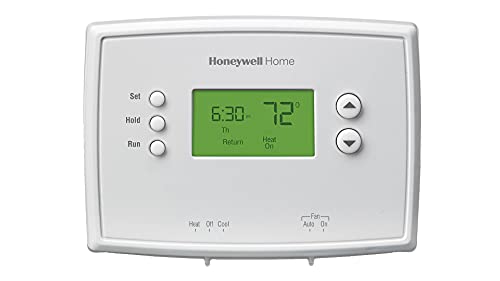
Honeywell Home RTH2300B1038 5-2 Day Programmable Thermostat
Top Pick
Honeywell Home RTH2300B1038 5-2 Day Programmable Thermostat
The RTH2300B1038 is the classic weekday and weekend programmable option in this group. Its 5-2 day format matches the rhythm of a household that leaves at roughly the same time Monday through Friday and follows a different pattern on Saturday and Sunday. Each day can use up to four periods, commonly described as wake, leave, return, and sleep, so the home can be warm or cool when occupied and eased back when empty or overnight. Push-button controls and a backlit digital display keep daily adjustments straightforward, and the thermostat retains its programming in permanent memory, so a battery change or an outage does not wipe the schedule.
Compatibility is broad for a basic model. Listing and manual information describe support for gas, oil, and electric furnaces, central air conditioners, hot water systems, millivolt systems, and heat pumps without auxiliary heat. That last limit is important: a heat pump system that relies on auxiliary heat stages needs a different model. Temperature control accuracy is listed at plus or minus one degree Fahrenheit, which is standard for this class. The unit runs on two AAA alkaline batteries, shows a low-battery warning well in advance, and includes reminders that help track battery and filter changes.
Who It Suits
This model suits a household with a predictable workweek that wants set-and-forget scheduling without Wi-Fi, apps, or a C-wire. It is a poor fit for a heat pump with auxiliary heat, for anyone who wants a different schedule every day, or for a home that needs remote control while away.
Honeywell Home RTH5160D1003 Non-Programmable Thermostat
Runner-Up
Honeywell Home RTH5160D1003 Non-Programmable Thermostat
The RTH5160D1003 takes the opposite approach: no schedule at all. It is a non-programmable thermostat that simply holds the temperature it is set to, with a backlit display that shows the current temperature and the set point at the same time. For many homes that is a feature rather than a limitation. There is no program to set up, no override that expires at the next period, and no confusion for guests or tenants about why the temperature changed on its own. Its installation guide describes a thermostat that always requires its two AA alkaline batteries, because a common wire does not power the display or operation on this model, which makes its battery powered nature unambiguous.
System coverage is wider than the simpler label suggests. Product information describes support for conventional forced air, heat pump, radiant heat from a boiler, and cool-only systems, with support for up to two heating stages or one compressor stage configurations described in its setup documentation. Automatic changeover between heating and cooling is included, which helps in spring and autumn weather that swings between the two in a single day. The mounting system uses the UWP wall plate described in the guide, and the low-battery icon is documented as appearing about two months before the batteries are depleted, with an annual replacement recommended even if the icon has not appeared.
Who It Suits
This model suits occupants who are home at varied hours, landlords who want a control tenants cannot misprogram, and anyone replacing a manual thermostat who wants a clear digital readout without scheduling. It is not the right choice for a household that wants the temperature to change automatically while away or asleep.
Orbit 83521 Clear Comfort Programmable Thermostat
The Orbit 83521 Clear Comfort is built around readability. Its large display is the headline feature, with a warm backlight intended to make the temperature easy to check at a glance. Under that display sits the most flexible scheduling in this guide: 7-day programming with up to four periods per day, so each day of the week can follow its own pattern. That suits shift workers, households with midweek days off, and anyone whose Saturday routine looks nothing like the Tuesday routine. Listing information describes temperature control accuracy of plus or minus one degree Fahrenheit and compatibility with gas, oil, and electric furnaces and heat pump systems, and the manufacturer states that the thermostat requires three AAA alkaline batteries, which are not included.
Consumer Reports information on this model describes it as using an internal disposable battery as its primary power, with no C-wire required and two-wire compatibility, which underlines its fit for older wiring. The manufacturer lists a three-year limited warranty. The early start style functions described for this family of thermostats aim to begin recovery before a programmed period so the home reaches the set temperature at the scheduled time rather than starting from it. As with any battery model, the three-cell requirement is worth noting before ordering, since the thermostat will not run on a pair of spare AA cells from a drawer.
Specs
Specification
Detail
Brand and model
Orbit 83521 Clear Comfort
Type
Programmable thermostat
Programming
7-day, up to 4 periods per day
Power source
3 AAA alkaline batteries, not included
Display
Large backlit LCD display
Temperature accuracy
Plus or minus 1 degree Fahrenheit
Compatibility
Gas, oil, and electric furnaces and heat pump systems
C-wire
Not required
Warranty
3-year limited, per manufacturer
ASIN
B01D16HAFW
Who It Suits
This model suits readers who prioritize a large, easy-to-read display and a different schedule for each day of the week. It is less convenient for anyone who wants batteries included in the box or who strongly prefers the two-cell arrangement used by the other models in this guide.
LuxPro P711 Programmable or Non-Programmable Thermostat
LuxPro P711 Programmable or Non-Programmable Thermostat
The LuxPro P711 is the flexible middle ground in this guide. Listing information describes it as a thermostat that can be set up as 7-day programmable, 5-2 day programmable, or fully non-programmable, so the same unit can follow a detailed schedule in one home and act as a simple hold-a-temperature control in another. That flexibility is useful in a rental property, a guest house, or a home whose occupancy pattern may change, because the operating mode can change without replacing the hardware. It runs on two AA batteries, which are listed as included, and its power source is listed simply as battery powered.
Because the P711 can be configured in several ways, buyers should plan a few extra minutes during setup to choose the programming mode deliberately. A home empty on weekdays benefits from a programmed setback, while a home occupied around the clock may be better served by the non-programmable mode. Confirming the equipment type and stage count against the listing before ordering remains essential, and line-voltage baseboard systems remain outside this low-voltage category.
Who It Suits
This model suits households that are unsure whether they want a schedule, properties where occupancy changes between seasons or tenants, and buyers who want one thermostat style they can configure either way. It is a weaker fit for anyone who wants the absolute simplest setup with no operating mode to choose at installation.
Frequently Asked Questions
Does a battery powered thermostat need a C-wire?
No. Avoiding the C-wire is the main reason to choose one. These thermostats run on replaceable AA or AAA batteries and use the existing low-voltage heating and cooling wires only to signal the equipment. That makes them a practical option for older homes, rentals, and cabins where the thermostat cable has no spare common wire. The trade-off is maintenance: the batteries must be replaced on schedule, because a thermostat with depleted cells cannot call for heating or cooling.
How long do the batteries usually last, and what happens when they run low?
Battery life varies with the model, the display backlight use, and how often the thermostat cycles the equipment, which is why manufacturers commonly recommend replacing the batteries once a year even when no warning is showing. The Honeywell models in this guide display a low-battery message well before the cells are depleted, in one case about 60 days in advance and in another about two months in advance, giving plenty of time to act. Settings on these models are stored in permanent memory, so a prompt battery change does not erase a schedule, although the clock and day may need resetting on some models.
Can a battery powered thermostat run a heat pump?
Some can, but the details matter. The RTH2300B1038 is described as suitable for heat pumps without auxiliary heat, while the RTH5160D1003 covers heat pump systems among its supported types. Auxiliary and emergency heat stages, and the number of heating stages a system has, are the points most likely to rule a basic model out. Checking the equipment nameplate and the thermostat compatibility list before ordering is essential, and a heat pump with auxiliary heat that is matched to the wrong thermostat can leave the auxiliary stage uncontrolled.
Are battery powered thermostats compatible with electric baseboard heating?
Generally no, not the models in this guide. Electric baseboard heaters are usually line-voltage systems, and the thermostats covered here are low-voltage controls for furnaces, boilers, central air conditioners, and heat pumps. Line-voltage heating needs a thermostat rated specifically for that duty. If a home mixes a low-voltage central system with a baseboard zone, each zone needs its own correctly rated control.
Final Verdict
For most households with a regular workweek, the Honeywell Home RTH2300B1038 is the natural starting point: its 5-2 day schedule, four daily periods, permanent memory, and two AAA batteries cover the classic no-C-wire use case with the least fuss. Households that want no schedule at all should look at the Honeywell Home RTH5160D1003, whose always-battery operation, backlit dual-temperature display, and automatic changeover make manual control as simple as it gets. Readers who need a different schedule every day, or who value a large display above all else, are better matched by the Orbit 83521 Clear Comfort and its 7-day programming on three AAA batteries. The LuxPro P711 is the hedge against uncertainty, since it can be configured as programmable or non-programmable on two AA batteries.
Whichever model is chosen, the same closing checks apply. Confirm the equipment type and stage count, confirm that the system is low voltage rather than line voltage, note the battery size the thermostat needs, and set a yearly reminder to replace the cells before the low-battery warning ever appears. A battery powered thermostat is deliberately simple technology, and with those basics handled, that simplicity is exactly its strength: reliable heating and cooling control on wiring that a powered smart thermostat could not use at all.
Product and ASIN Reference
Product
ASIN
Honeywell Home RTH2300B1038 5-2 Day Programmable Thermostat
B00CTSY6G0
Honeywell Home RTH5160D1003 Non-Programmable Thermostat
B079Q5MKHQ
Orbit 83521 Clear Comfort Programmable Thermostat
B01D16HAFW
LuxPro P711 Programmable or Non-Programmable Thermostat
B0195ERGZ8
9
99klik Editorial Team
We compare specs, materials and verified owner reviews before a product earns a spot. Rankings are never paid.
Affiliate disclosure. As an Amazon Associate we earn from qualifying purchases at no extra cost to you. Prices accurate as of the date shown.
Compare five 5G capable phones for everyday use, from a simple large-screen handset to a rugged outdoor model, with storage, display, and carrier guidance.
Best ultralight electric scooters for adult urban travel: five folding scooters at or under 31 lb for stairs and trains, compared for weight and brakes.
Best Roland portable digital pianos: five 88-key Roland pianos for home practice, lessons and gigs, compared for touch, tone, speakers and portability.
Find the best action cameras for skiing, from cold-proof flagships to a 360 camera and a value pick. Compare stabilization, battery life, and ski mounts.
The best mattresses for someone under 125 pounds: soft and medium beds that give way under a lighter sleeper, from a plush queen to narrow and standard twins.

 Honeywell Home RTH2300B1038 5-2 Day Programmable Thermostat
 Honeywell Home RTH5160D1003 Non-Programmable Thermostat
 LuxPro P711 Programmable or Non-Programmable Thermostat